
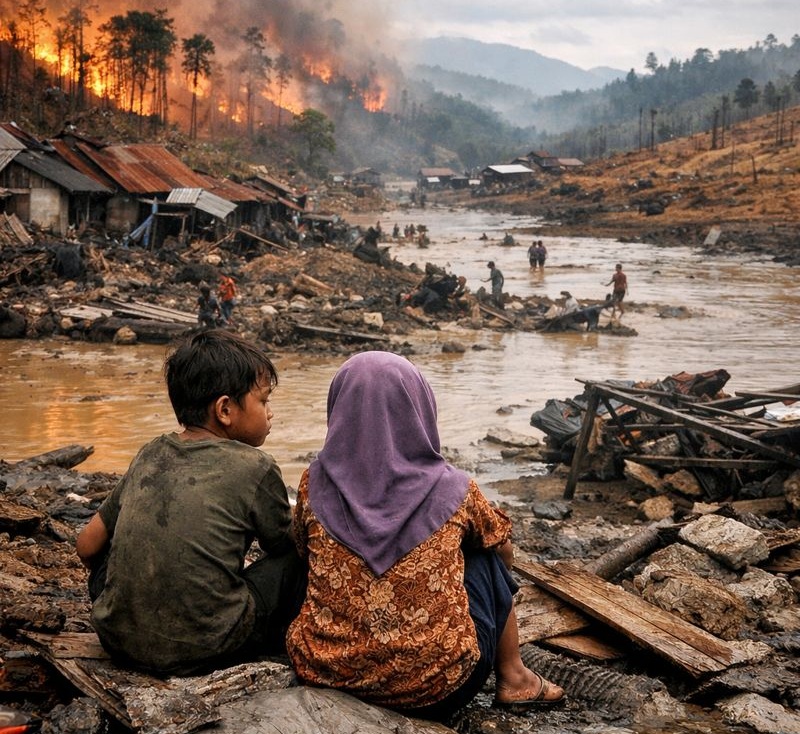
In parts of Sumatra, disaster has become an almost familiar word. One season, the sky turns orange as peatlands burn and thick haze creeps into classrooms and hospitals. Another season, rivers overflow, hillsides collapse, and villages are swallowed by mud. For many families in Aceh, North Sumatra, and West Sumatra, these are no longer isolated events but part of a recurring pattern that reshapes everyday life.
These calamities are often described as natural disasters. Yet calling them “natural” risks hiding a deeper truth. What we are witnessing is not simply the work of climate and weather. It is the outcome of a development path that has steadily weakened the ecological foundations of society, while celebrating growth in numbers that tell only half the story.
Indonesia’s economy continues to be judged, above all, by the rise and fall of gross domestic product. When GDP grows, we speak of success. When it slows, we worry. But Sumatra’s experience raises an uncomfortable question: what does it really mean to grow, if that growth rests on burning forests, drained peatlands, and eroded hillsides that later unleash catastrophe?
In a recent public debate, economist Muhammad Syarkawi Rauf warned that disasters in Sumatra could slash regional productive capacity by as much as half and threaten national growth targets. Such projections remind us that environmental shocks carry real economic consequences. Yet they also expose a deeper flaw. In our economic thinking, disasters appear as external interruptions to an otherwise healthy system, rather than as symptoms of a model that has quietly exhausted its own natural support.
The GDP Illusion: Accounting Without Nature
GDP, after all, was never designed to measure the health of ecosystems. It counts the value of goods and services produced, but not the condition of the soil, forests, rivers, or air that make production possible in the first place. When forests are cleared for plantations or mining, GDP rises. When the same loss of forest cover later weakens watersheds and triggers floods or landslides, the erosion of natural wealth is nowhere to be found in the accounts. The destruction remains invisible, even though it undermines the very productivity GDP claims to represent.
This paradox has troubled economists for decades. As early as the 1970s, thinkers like William Nordhaus and James Tobin questioned whether growth figures meant much if they ignored environmental damage. Later, Joseph Stiglitz and Amartya Sen argued that GDP was a misleading compass for judging social progress. More recently, Partha Dasgupta’s work on biodiversity pushed the point further, insisting that societies are running down their stock of natural assets without ever recording the loss.
Yet in Indonesia, as in many countries across the Global South, policy debates still revolve around how fast GDP grows, not how that growth is achieved. Roads, mines, plantations, and industrial estates are welcomed as engines of development because they promise immediate output. Rarely do we ask what is being traded away to make that output possible.
The recent disasters in Sumatra make that trade-off painfully clear. Independent estimates suggest that the economic losses from floods and landslides have reached tens of trillions of rupiah, while reconstruction will demand equally massive public spending. In Aceh alone, the damage far exceeds what the province earns in a year from extractive revenues. In simple terms, the short-term fiscal gains from exploiting land and forests do not come close to covering the long-term costs borne by society when ecological buffers collapse.
This is what might be called illusory accounting. We treat extraction as income, but never record ecosystem degradation as depreciation of national wealth. Forests, peatlands, and river basins are not just scenery; they are productive capital. They regulate water flows, stabilize soils, store carbon, and reduce disaster risks. Ignoring their depletion is like celebrating profits from selling parts of a factory while pretending its productive capacity remains intact. Sooner or later, the losses show up, not in balance sheets, but in human suffering and mounting public bills.
Power, Participation, and Intergenerational Injustice
Behind this accounting illusion lies a political economy that rewards short-term gains. Local governments compete for investment. Corporations seek quick returns. Politicians are under pressure to show visible growth within electoral cycles. The result is a bias toward projects that deliver immediate output, even if they quietly erode long-term resilience.
Here, the political insights of Robert Dahl are instructive. Dahl argued that democracy is not just about elections, but about whether those affected by decisions have a real voice in shaping them. In many parts of Sumatra, land-use decisions that transform forests into plantations or mines are made far from the communities who depend on that land for their livelihoods and safety. Villagers who later breathe the haze or face floods have little say when permits are issued. The voices that matter most are often those of investors and officials, not those who bear the consequences. This democratic deficit helps explain why development choices repeatedly favor extraction over protection.
Questions of justice also loom large. John Rawls once asked us to imagine designing society from behind a veil of ignorance, not knowing whether we would be rich or poor, or even which generation we would belong to. From that perspective, would anyone choose a model of growth that enriches a few today while leaving degraded land, polluted air, and climate instability to future generations? Rawls believed that each generation has a duty to preserve sufficient resources and opportunities for those who come after. By that standard, the relentless conversion of Sumatra’s forests is not merely unwise policy; it is a moral failure, a form of intergenerational injustice disguised as development.
If Dahl and Rawls help us see the democratic and ethical flaws in the current model, Elinor Ostrom points toward a more hopeful path. Through decades of research, Ostrom showed that local communities around the world are often capable of managing shared resources sustainably when they are given rights, trust, and responsibility. Forests, fisheries, and irrigation systems have endured for generations under community rules crafted from local knowledge. Where communities are empowered, they tend to protect what sustains them.
This lesson matters deeply for Sumatra. Many indigenous and rural communities have long traditions of caring for forests and land, yet their authority has been eroded by centralized policies and commercial concessions. Bringing them back into the heart of resource governance is not just about cultural recognition. It is about effectiveness. A development model that excludes local stewards in favor of distant bureaucracies and corporations is far more likely to fail ecologically.
Sumatra’s story is not unique. Across the Global South, similar patterns unfold. Forests fall for soy, cocoa, timber, and palm oil. Rivers are dammed or polluted for industry. Lands are mined for minerals that feed global supply chains. Each project adds to GDP. Each is celebrated as progress. Yet together they produce a landscape of growing vulnerability, where communities become more exposed to floods, droughts, fires, and disease.
There is a bitter irony here. Many countries of the Global South are still striving to overcome poverty and close the gap with richer nations. The promise of growth is understandably powerful. But in chasing the same extractive path once taken by today’s industrialized countries, they risk locking themselves into a cycle of ecological decline and social instability. What appears as catching up may instead be repeating an old mistake under harsher climate conditions.
Beyond GDP: Toward Green Accounting and Resilient Development
This is why the idea of green GDP deserves serious attention. At its core, green GDP seeks to adjust economic growth figures by subtracting the costs of environmental degradation and resource depletion. It asks a simple question: if forests shrink, soils erode, water is polluted, and health suffers, can we really say the economy has grown? A green GDP would not treat nature as a free input but as an asset whose loss counts as an economic loss.
Closely related is the idea of inclusive wealth, which measures a nation’s true prosperity as the sum of its produced capital, human capital, and natural capital. Under this lens, a country may be building roads and factories, but if it is simultaneously destroying forests and degrading ecosystems, its overall wealth may be stagnating or even declining. Growth in output does not automatically mean growth in wealth.
Adopting such perspectives would not magically solve Sumatra’s problems. But it would change how success is judged and, in doing so, reshape incentives. If environmental losses show up in the same headlines as GDP figures, policymakers would find it harder to ignore them. Projects that look profitable in narrow terms might appear far less attractive once their ecological costs are visible.
Indeed, new metrics must be matched by new policies. What Sumatra needs is not only reconstruction, but reorientation. Pouring resources into rebuilding roads and bridges may restore growth figures, but without restoring ecosystems, reconstruction merely postpones the next disaster. Indonesia must shift from reactive responses to preventive, ecosystem-based development.
That means embedding environmental limits into spatial planning. It means enforcing land-use rules in vulnerable watersheds and peatlands. It means treating forest and peat restoration not as peripheral environmental programs but as core economic policy. And it means rethinking fiscal priorities so that investment in resilience is seen as a foundation of prosperity, not a burden on budgets.
Investing in prevention is not only morally right; it is economically rational. Each rupiah spent on protecting watersheds, strengthening local stewardship, or restoring degraded land can save many more in future losses, not to mention lives. Yet prevention rarely makes headlines. It does not boost GDP quickly. It does not cut ribbons. Its benefits appear slowly, often after political terms have ended. This is precisely why a broader measure of progress is needed, one that values what is preserved as much as what is produced.
The gap between economic statistics and lived reality is now painfully visible in Sumatra. GDP may recover once reconstruction begins. But for families who have lost homes, farmland, or loved ones, the damage is permanent. No economy can flourish on land that keeps sliding and rivers that keep overflowing.
Indonesia now faces a choice that echoes across the Global South. We can continue celebrating growth numbers that ignore ecological erosion, or we can redefine progress in a way that reflects the true foundations of prosperity. We can persist with a model that treats nature as expendable and communities as collateral, or we can build one that sees ecosystems as infrastructure and people as partners.
The lesson from Sumatra is clear. Without bringing nature into our economic ledger, growth will remain an illusion, impressive on paper but fragile in reality. True development must mean more than rising output. It must mean healthier landscapes, safer communities, fairer participation, and a future that does not mortgage itself for short-term gain.
The disasters that scar Sumatra today are a warning written in fire and flood. Whether they become merely another chapter in a cycle of loss, or a turning point toward a more just and resilient path, depends on whether we are willing to look beyond GDP and ask what kind of progress we truly want.

M. Nadzirummubin is a researcher and Co-Founder of the Creative Development Institute, with a Master’s degree in Economic Planning and Development Policy from Universitas Indonesia (UI). His work focuses on sustainable development, public policy, and development planning, with particular attention to inclusive and long-term socio-economic transformation.

Ghulam Ruchma Algiffary is a researcher at the Institute for Transformative Research on Sustainability and Religious Action (INTIRA) and serves as President of the Alumni Association at Universitas Islam Internasional Indonesia (UIII).
This article argues that recurring disasters in Sumatra expose the...
This article explores Spivak's contribution to political and intellectual legacy....
This article critically examines Indonesia’s new capital project, IKN, which...
This article traces how Indonesia’s everyday teh botol and the...
This article examines how communities in Pekalongan, Indonesia, are responding...
This article analyses how to reorient Pakistan from a forgotten...
This article challenges the conventional view that all corruption is...
This article explores how interfaith iftar gatherings in Indonesia and...
This article examines the controversial election of Mahamoud Ali Youssouf...
This article examines how Iran employs Islam as a strategic...
Many people assume that religious authorities can more easily mobilize...
H.O.S. Tjokroaminoto, hailed as "The Uncrowned King of Java," was...
In Indonesia Menggugat, Sukarno delivers a searing indictment of colonial...






Leave A Comment