

Critical minerals, vital components in electric vehicle batteries, wind turbines, fighter jets and guided missiles, are at the center of major power rivalry and supply chain vulnerabilities. In a landmark policy shift early this year, Chinese authorities implemented a sweeping "zero tolerance" stance against the smuggling of strategic minerals. According to the UN 2025 report, growing demand for minerals is amplifying the risks of forced labour displacement, environmental damage, and illegal armed conflict financing in the mineral supply chain. Reports underline the role of organized crime groups, weak regulatory oversight across the porous borders to add to the menace.
This illicit trade network is prevalent in regions with weak institutions and high mineral wealth, notably in parts of Africa, Latin America and Southeast Asia perpetuating a "resource curse" as the region’s untapped minerals yield poverty and violence instead of growth.
Key Regional Smuggling Hubs
Africa
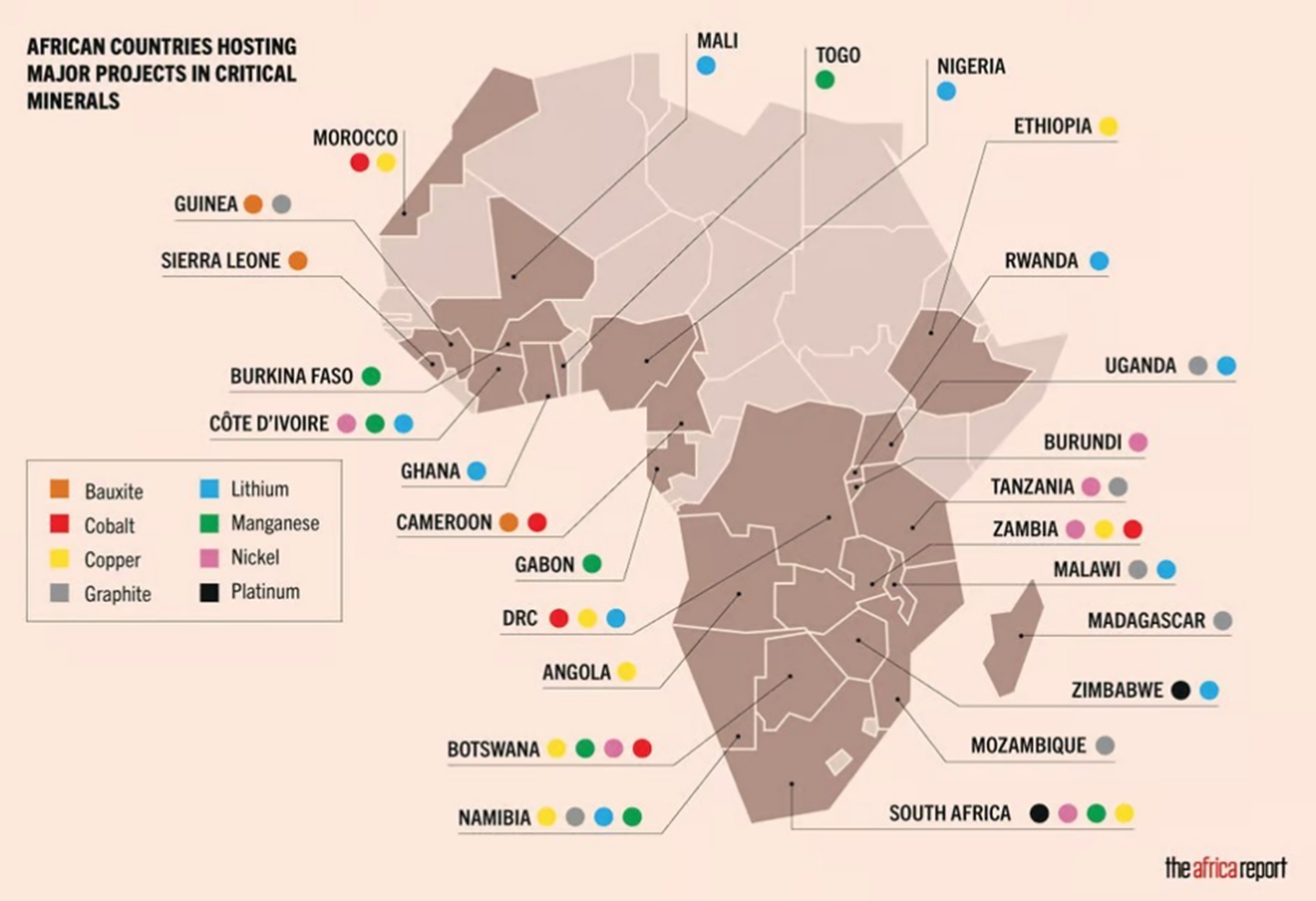 Image Courtesy: Africa Minerals Group.
The illegal mining of critical minerals is a significant and growing issue in Africa, home to some 30% of the world's mineral reserves. Countries like the Democratic Republic of Congo (DRC), Zimbabwe, and Zambia are particularly affected, facing serious socio-ecological and economic consequences.
In Democratic Republic of Congo, various national and foreign armed groups like the Alliance Fleuve Congo (AFC) rebel coalition (which includes the M23 armed group), Mai-Mai, and others, profit extensively from the control and illicit trade of minerals like gold, tin, tantalum, and tungsten (often referred to as 3Ts). In 2024 itself, AFC forces seized control of the Rubaya mining site in North Kivu, which produces a significant percentage (20-30%) of the world's coltan (the ore for tantalum).This financing allows the AFC to sustain its operations and expansion across its established "parallel administration" in the territories it controls.
These resources are often smuggled into neighboring countries like Rwanda and then "laundered" into the global supply chain as "legal" exports. Open source reports have even claimed, Rwandan authorities have inflated domestic production figures of tin, tungsten and tantalum in order to disguise its exporting of smuggled minerals from Congo.
Armed and terrorist groups, such as the JNIM( Jama’at Nusrat al Islam wal Muslimeen) and Islamic State in the Greater Sahara (ISGS) in the Sahel Region (Mali, Burkina Faso, Niger) , Patriotic Rally for the Renewal of the Central African Republic (RPRC), using the profits of illegal trading to finance their activities and engage in violence.
Latin America
Latin America holds one-third of the world's critical mineral reserves.
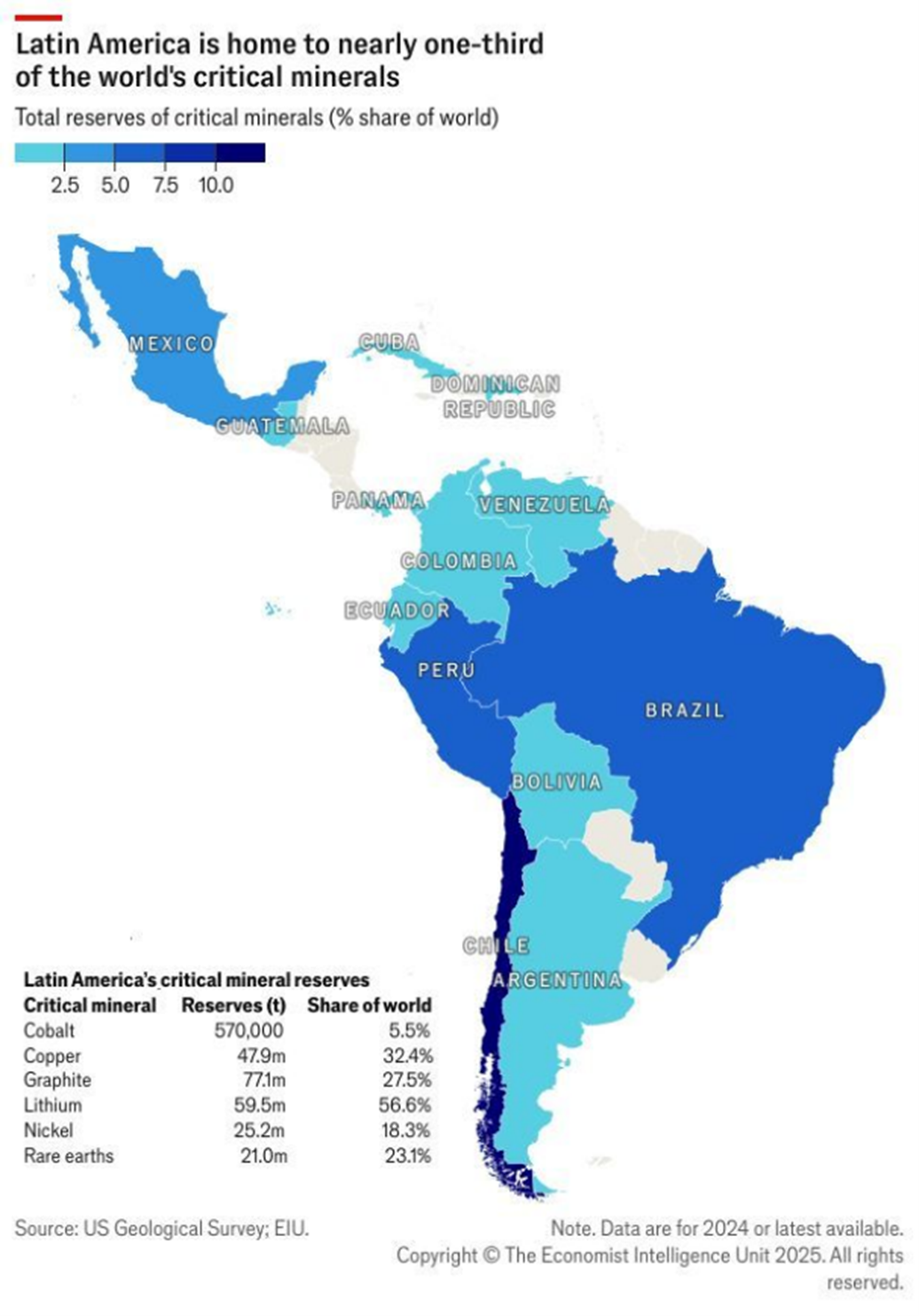
Image Courtesy: Twitter
Critical minerals smuggling in South America is a significant and growing problem, primarily centered around the Colombia-Venezuela border and the Amazon Basin.
Nearly all major criminal organizations in the region are involved in some aspect of illegal mining. Notable rebel armed groups like Acacio Medina Front( FARC dissident group), National Liberation Army ( Colombia’s largest active guerrilla group), Red Command ( Brazil), Los Lobos have expanded their presence, capitalizing on gold mining as a profitable financing source through extortion schemes. Even the Venezuelan National Guard ( a gendarmerie component of the National Armed Forces of Venezuela) have been documented to be participating in the trade, sometimes in cooperation with armed groups.
Interviews with miners, traffickers, mineral traders and law enforcement agencies reveal that critical minerals from the Amazon can be traced to exporters in large port cities connected to international trade routes.
Southeast Asia
Southeast Asia has emerged as a dominant force in global critical minerals energy security markets. Unregulated and illegal mining for minerals in Southeast Asia, essentially in the Mekong region has increased significantly. Myanmar is a primary example of how armed conflict intertwines with critical mineral smuggling. Ethnic armed organizations like the Kachin Independence Army (KIA) control most of the rare-earth mining belt in northern Myanmar. The revenue from illegal trade is used to fund the ongoing conflict between the military regime and various resistance groups, further destabilizing the region. While the connection between armed groups and minerals is most stark in Myanmar, other countries like Malaysia, Indonesia and Vietnam too face significant illegal mineral trade routing challenges.
Regulatory Mechanisms in Progress
UNICRI (United Nations Interregional Crime and Justice Research Institute)has highlighted weak governance and corruption as key drivers of crime in the Critical Minerals sector. In order to tackle the evolving challenges, UNICRI has developed the Strategic Response Framework for Tackling Crimes Linked to Critical Minerals closely aligned with the UN Secretary-General’s Panel on Critical Energy Transition Minerals.This comprehensive framework outlines a coordinated approach to mitigating the various crimes associated with critical minerals. It underlines the importance of empowering national stakeholders, enhancing legal and regulatory frameworks, and promoting international collaboration.
Regulatory strategies to combat critical mineral smuggling in Africa, Latin America, and Southeast Asia focus on identifying blind spots and configuring mechanisms that can strengthen regulatory oversight and ensure ethical and sustainable practices and supply chain transparency.
In Africa key frameworks and deals like African Green Minerals Strategy (AGMS, 2023),Lobito Corridor (2023-ongoing),Minerals Security Partnership (MSP, 2022),U.S.-DRC-Rwanda "Minerals for Peace" (2025), have been agreed upon adopting measures to prevent and mitigate illicit flows, and enhance traceability.
In Latin America, key frameworks and agreements like Escazú Agreement (2018-), OECD Due Diligence Guidance (2016-), address the various facets of mineral trafficking and securing the supply chains.
In Southeast Asia key frameworks and agreements like US-Cambodia/Vietnam Trade Pacts, ASEAN Minerals Cooperation Action Plan (AMCAP-IV, 2025) stress on building resilient and secure supply chains.
An array of preventive measures has been strategised for adoption by supply chain mineral rich countries that includes third-party audits, enhancing traceability (tech-based & site-specific), improving cross-agency coordination (customs, police, regulators), boosting financial intelligence, building specialized training for mining-related crimes, and engaging local communities. Countries are also developing clear regulations, incentives, and ESG (Environmental, Social, Governance) compliance to attract investment for mining and processing.
A smart technology driven roadmap that includes better use of digital tools for tracking minerals will enable improved evidence collection of granular, location-based data in the remote mining sites, helping foster collaboration between mining agencies, customs, police, and anti-corruption bodies. Most importantly, cross regional collaboration is important for cross regional trafficking to avert illegal trafficking.

Dr. Angana Guha Roy is currently working as an Associate Director at the Asian Institute of Diplomacy and International Affairs, Kathmandu. She writes on Foreign Policy, Geopolitics, Defence and National Security, and other prominent issues in International Relations. Please contact her at : anganaguharoy@gmail.com
In this article, Affabile Rifawan examines the shifting landscape of...
This article examines how Indonesia’s nickel downstreaming policy has driven...
This article examines the "permission economy" in Pakistan, an informal...
This article examines how the illicit smuggling of critical minerals...
This article argues that poverty and uneven development in the...
This article explores how the Global South is reevaluating its...
This article examines the challenging path for Indonesia to meet...
This article analyzes Nigeria’s attempt to convert carbon credits into...
This article examines how Indonesia’s MBG program, while reaching more...
This article critically analyzes the 17th BRICS Summit communique, highlighting...
This article explores what Indonesia’s upcoming Digital Rupiah can learn...
This article explores how Indonesia can transform its steady economic...
This article discusses how global ESG standards, mainly created within...
This article explores Indonesia’s resilient people-based economy, driven by 65...
This article examines Indonesia’s 2025 economic turmoil, marked by a...
This piece explores how Pakistan can harness its rich cultural...
This incisive piece unpacks the deeper logic behind Trump’s so-called...
This article introduces Sustainable Prosperity Investing (SPI) as a hybrid...
This article examines how globalization challenges the authority of Islamic...
This article examines Danantara, Indonesia’s recently launched sovereign wealth fund...
This article explores how digital payment systems are reshaping financial...
This article explores the expansion of Islamic banking beyond Muslim-majority...
This article examines the impact of Trump’s aid cuts on...
Nestled within the Singapore-Johor-Riau Growth Triangle, Bintan Island has quietly...



Leave A Comment