
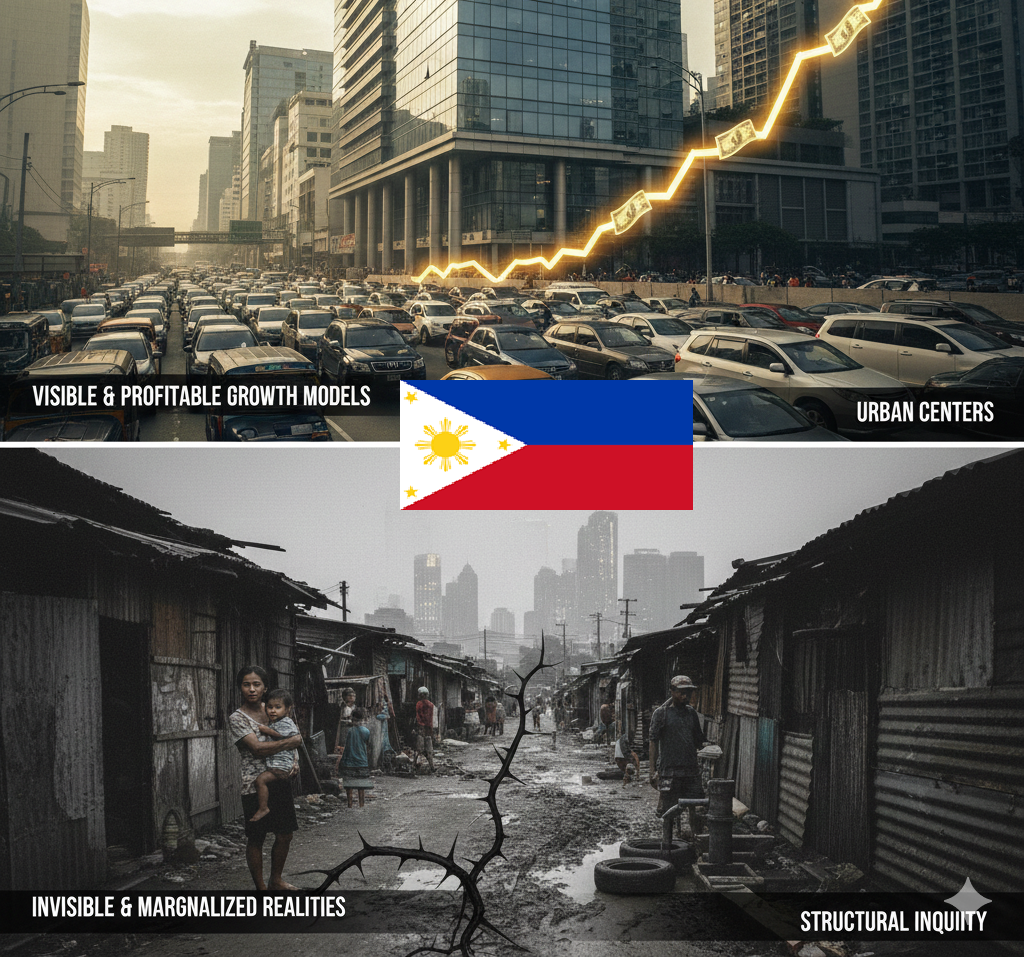
Economic growth in the Philippines is often celebrated as evidence of national progress, yet for millions, prosperity remains distant and unevenly distributed. Despite rising GDP figures and expanding urban centers, development continues to concentrate wealth, opportunity, and infrastructure in the hands of a few. Meanwhile, prosperity remains an increasing distant goal for the majority of the population, mostly those living rural and peripheral communities structurally marginalized. This persistence of inequality is not accidental but rooted in historical extraction, elite capture, weak redistributive institutions, and development models that prioritize visibility and profit over inclusion. Visible and profitable growth models, elite capture, and inadequately redistributive systems ensure that economic inequality will continue to be a prominent feature. The economic growth of the country shown through national economic indicators only serves to mask the everyday struggles of countless Filipinos across the archipelago. This article examines the daily life of Cavite which perfectly encapsulates the ongoing systems of exclusion that ensure growth remains uneven and economic inequality endures.
The communities in Cavite Province perfectly illustrate the national issue at hand. Cavite is considered the emblem of progress in the Philippines for its industrial parks, investments, and closeness to Metro Manila. Yet, the lived reality of many Caviteños suggests that progress does not mean decreasing poverty for everyone. The same is true for other areas of the country. Urban areas undergo rapid growth, while rural provinces remain underserved. There is a growing inequity in the urban core areas as well, with large informal settlements, underemployment, and unreliable access to essential services. Rural-urban migration is also highly prevalent.
The Philippines is multifaceted, and so is poverty. The inter-related aspects of a family's social and economic condition such as lack of access to quality and for profit education, inadequate healthcare, underemployment, soaring cost of living, and the informal economy are all factors that shape poverty. In many areas, families are forced to adopt survival strategies that include having several livelihoods, engaging in informal-sector work, and/or micro-enterprises. Such strategies, while demonstrating the remarkable resilience of the people, equally highlight the absence of a dependable structure to provide support. The communities have to carry the weight of the systemic inequities as a result of the lack of a national policy framework. These inequities are essential to be resolved.
Urbanization has intensified these challenges. Metro Manila, Cebu, Davao, and surrounding urban corridors attract large numbers of migrants seeking employment. However, the rapid growth of cities has outpaced infrastructure development and social services. Informal settlements expand as affordable housing remains scarce. Public transportation systems become overcrowded, and access to clean water and sanitation is unreliable in many barangays. Urban poverty does not disappear through modernization. Instead, it becomes more complex.
Rural areas face a different yet equally difficult reality. The decline of agriculture continues as farmers struggle with inadequate government support, rising production costs, and vulnerability to typhoons and droughts. Land conversion for commercial and industrial use affects food security and displaces long-standing agricultural communities. Provinces such as Eastern Samar, Masbate, Lanao del Sur, Abra, and many others continue to experience high poverty rates because of weak infrastructure, limited livelihood opportunities, and slow disaster recovery.
Governance remains a central factor in the persistence of poverty nationwide. Program implementation varies across local government units, and many poverty alleviation initiatives lack continuity because of political changes every election cycle. The presence of political dynasties in many regions influences resource allocation, limits transparency, and weakens long-term planning. These conditions reflect a broader pattern found across the Global South where elite networks shape policy outcomes and restrict inclusive development.
The national poverty situation is further complicated by unequal labor conditions. Many Filipinos rely on precarious work such as short-term contracts, informal labor, and low-wage factory jobs. This pattern is observable in export processing zones nationwide, including Cavite, Laguna, Batangas, Cebu, and parts of Mindanao. Workers participate in the formal economy, yet they remain trapped in a cycle of instability because wages and working benefits cannot keep up with the rising cost of living.
Poverty in the Philippines therefore requires more than economic growth to be solved. The issue calls for national strategies that center equity, access, and social justice. Investments in public education, rural development, healthcare, and stable employment are essential. There is a need for policies that support farmers, protect workers, strengthen disaster resilience, and ensure that urbanization benefits entire communities rather than only investors and political elites.
Cavite’s situation reminds the country that local experiences must inform national policy. Poverty is not an abstract statistic. It shapes daily decisions, opportunities, and the future of millions of Filipinos. By understanding how poverty persists even in economically advanced provinces, policymakers and development institutions can better recognize the deeper structural issues that affect the entire nation.
In the Philippines, the poverty that comes as a result of low income is only the tip of the iceberg in a plethora of social issues that include accessibility, governance, social inequity and injustice. To address poverty, pillars of all inclusive, equitable, and sustainable economic growth should be put in place and embraced on a national level. Empathy driven holistic inclusive growth is the only path the Philippines can take in order to attain a future where growth is equitable and progressive.
The Philippine experience reflects a wider Global South dilemma, where economic growth occurs alongside poverty, inequality, land and other assets dispossession, and political silencing. Development has always been framed in socioeconomic terms and in the Global South, the over dominant economic growth model is neoliberal. In the Philippines and across the globe, this inequality should be analyzed from the lens of underdeveloped, not failing, national systems of governance that build on social inequity and place capital over social justice. To reframe Global South development, unequal social systems that hyper extend growth should be the main focus.

Jonel Garcia is a Political Science graduate and a licensed Professional Teacher in the Philippines. He currently serves as a faculty member at National University–Philippines, where his academic interests include governance, social inequality, and development studies.
In this article, Affabile Rifawan examines the shifting landscape of...
This article examines how Indonesia’s nickel downstreaming policy has driven...
This article examines the "permission economy" in Pakistan, an informal...
This article examines how the illicit smuggling of critical minerals...
This article argues that poverty and uneven development in the...
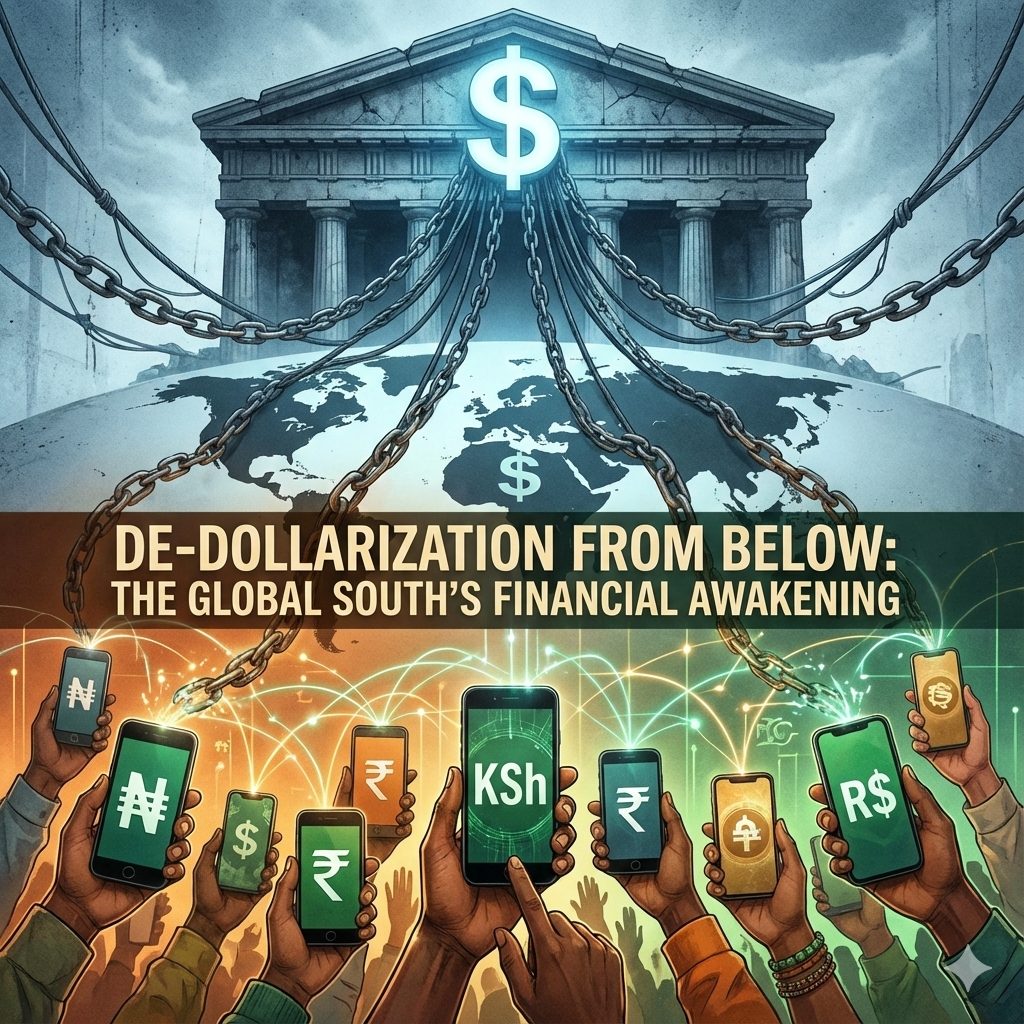
This article explores how the Global South is reevaluating its...
This article examines the challenging path for Indonesia to meet...
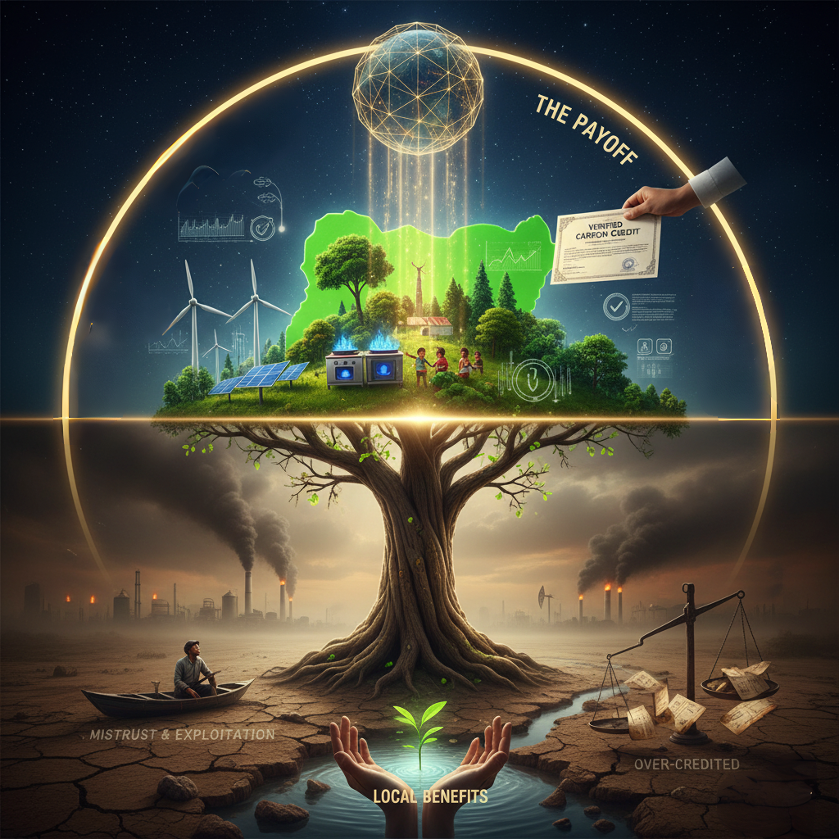
This article analyzes Nigeria’s attempt to convert carbon credits into...
This article examines how Indonesia’s MBG program, while reaching more...
This article critically analyzes the 17th BRICS Summit communique, highlighting...
This article explores what Indonesia’s upcoming Digital Rupiah can learn...
This article explores how Indonesia can transform its steady economic...
This article discusses how global ESG standards, mainly created within...
This article explores Indonesia’s resilient people-based economy, driven by 65...
This article examines Indonesia’s 2025 economic turmoil, marked by a...
This piece explores how Pakistan can harness its rich cultural...
This incisive piece unpacks the deeper logic behind Trump’s so-called...
This article introduces Sustainable Prosperity Investing (SPI) as a hybrid...
This article examines how globalization challenges the authority of Islamic...
This article examines Danantara, Indonesia’s recently launched sovereign wealth fund...
This article explores how digital payment systems are reshaping financial...
This article explores the expansion of Islamic banking beyond Muslim-majority...
This article examines the impact of Trump’s aid cuts on...
Nestled within the Singapore-Johor-Riau Growth Triangle, Bintan Island has quietly...



Leave A Comment