
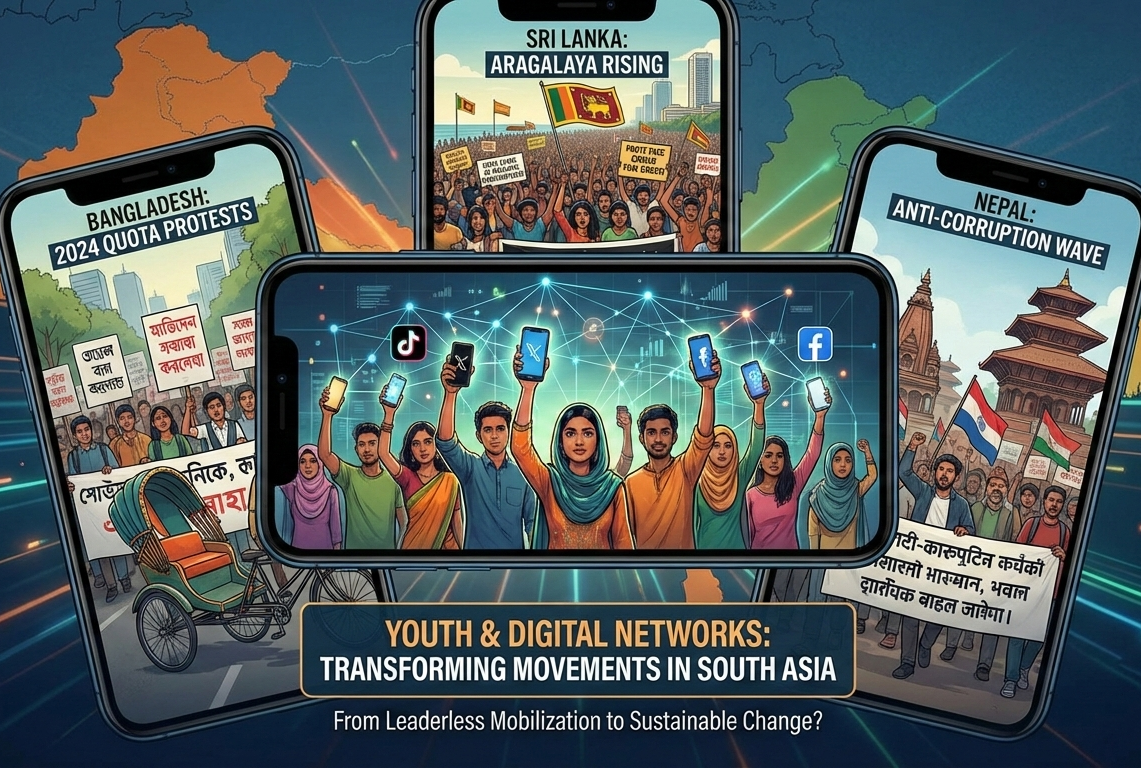
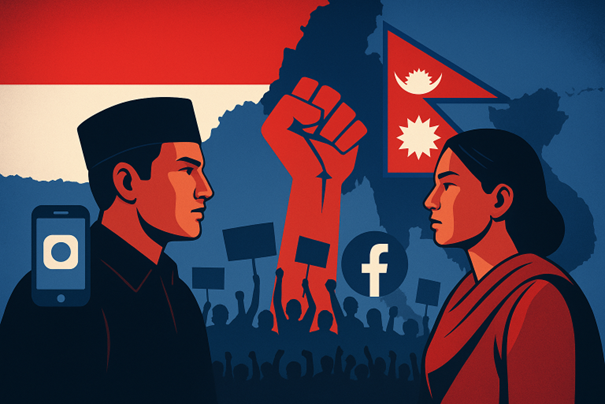
The more recent case of Bangladesh, Nepal, and Sri Lanka protests indicates a shift in the nature of social movements in South Asia. Contrary to party-controlled and ideologically oriented rebellions, such as the 1971 independence movement of Bangladesh or the Maoist insurgency in Nepal, the movements nowadays are leaderless, decentralized, and run by youth, mobilized by digital means. Even though this follows bigger trends in global activism, important concerns have been raised about whether such movements can be sustainable or have long-term effects.
Recent movements in the entire South Asia are a stark contrast to the past. Unlike the old protests that were formed around influential party officials and high-minded principles, the new ones are much more dynamic and decentralized. As an example, in Sri Lanka, the 2022 Aragalaya protests went off in the midst of an economic crisis, at a time when inflation was approaching 70% and various sections of the population joined forces to insist that President Gotabaya Rajapakse resign. Student protests against job quotas in 2024 in Bangladesh quickly turned into an anti-government movement which toppled the government of Prime Minister Sheikh Hasina and claimed over 300 lives. Equally, anti-corruption protests in Nepal in 2025 led to a change in policy after 19 deaths following anti–social media threats. All these movements were not organized, but the spontaneous mobilization has been going on via platforms such as X, Facebook, and TikTok.
However, the strongest factor behind these is a demographic one. Across South Asia, many young people struggle to find decent work. In several countries, youth unemployment among 15–24-year-olds exceeds 20 percent, and when those who are out of school, out of work, or stuck in insecure jobs are counted, overall youth joblessness in some contexts rises close to 30–40 percent. It contributes to gross economic mismanagement that has been driving popular frustrations through international plan-related debt crises such as China’s Belt and Road Initiative (BRI). Social media allows coordination to be carried out rapidly. In Nepal, the protesters spread their protest hashtags to the world. The Bangladeshi diaspora abroad increases the pressure on social media. It is the case that Manuel Castells referred to as networked social movements, where digital connectivity replaces the older hierarchies.
There are a number of strengths associated with this new model. Spontaneous movements are quicker to build than governments can act, as in Bangladesh, where the protests overcame the local campuses and spread to countrywide demonstrations within the space of several weeks. Lack of hardline ideology has encouraged inclusiveness that unites different communities, and this is rare in the cross-ethnic coalitions in Sri Lanka. Digital amplification expands the spectrum of such movements and attracts international attention and pressure, and this can be observed through protest storylines being circulated globally in Nepal.
All these combined contribute to the disruptive capacity of the model. The movements of this sort to a great extent bypass the traditional forms of gatekeeping like political parties and empower the already marginalized youth who in turn use their digital savvy against the established elites. Thousands of people in Colombo in Galle Face Green and millions of people online in Bangladesh indicate the potential to direct a large amount of dissatisfaction over inequality and state decay, and this is represented in the argument by Thomas Piketty that inequality is the source of instability.
But regardless of such energy and reach, the movements also have numerous challenges. These movements, which are usually leaderless, do not last long. Sri Lankan protests succeeded in achieving change in the regime but failed to translate that into policy change; it did not take long before old elites started gaining influence. The interim government of Bangladesh headed by Muhammad Yunus is at risk in a number of aspects due to religious and other competing groups and lack of a unified orientation. In Nepal, protests were able to overturn the ban on social media but did not do much to provoke deeper constitutional reforms.
There is also a lack of leadership which makes the contact with the authorities hard and most often results in violence. The number of 300 and 19 dead in Bangladesh and Nepal, respectively, indicates the dangers of disorganized action. In addition to this, generalized slogans like ending corruption cannot result in systemic change as opposed to previous movements, which had very specific slogans like the one that the people of Bangladesh fought for during their liberation in 1971. This is in accord with what Francis Fukuyama would call political decay, where there is a weakness in the institutions creating turmoil but they are resistant to permanent change unless they have structured leadership. Repeated risks of elite recapture, as in Sri Lanka, undermine long-term benefits of such protests.
The combination of these cases offers several lessons that can aid in formulating an idea of modern movements. First, they demonstrate that digital networks democratize activism by providing quick mobilization and inclusiveness but have vulnerability that generates the need to pursue hybrid approaches that combine spontaneity and organization. It was once proposed by the Transnational Institute that temporary alliances could be used to serve this post-protest energy into aligned agendas and avoid dispersal. Second, incorporating young people into systems of governance, as is being experienced in interim composition in the Bangladesh government, is useful in keeping the reform process going. Third, there is the possibility of regional cooperation on platforms like the South Asian Association for Regional Cooperation in matters that touch on debt, unemployment, and cross-border learning. One such instance is an example given by the organizers of the protests in Nepal who discussed the tactics that the protesters in Bangladesh had used.
What has been unambiguous in the changing environment of protests in Bangladesh, Nepal, and Sri Lanka is an apparent shift to decentralized, digitally powered activism by disillusioned young people. Though disruptive to the status quo, such movements often cannot sustain themselves because of their mostly leaderless and loosely structured nature. They are perhaps more open to new voices than old movements but lack the staying power of old movements. Increasingly, policymakers and scholars will be required to place value upon their contribution as an early warning of systemic breakdown and their contribution to providing direction on how to proceed on the more institutionalized path of follow-through. What the South Asian experience underscores, however, is that in any future movements, digital networks will be the key; however, on the issue of long-term transformation, it is a question of translating spontaneous outrage into institutional change. With the region becoming more prepared to embrace this transformation, the lesson rings farther than the region, indicating a complex balancing act between disruptive politics and long-term change in protest politics today.

Muhammad Aquib is a master’s student in Political Science specializing in International Relations at Universitas Islam Internasional Indonesia (UIII), with experience in policy-oriented research on politics, international relations, and human rights at think tanks.
In "Lebanon's chronic blackout issue is not just an engineering...
This article asks whether Indonesia is showing early symptoms of...
This article documents the systematic repression of Pan-African activists, journalists,...
This article looks at how Pakistan's 2024 General Elections were...
This article examines the tragic death of a child in...
This article examines poverty alleviation efforts in Kebumen Regency, Central...
This article critically examines Indonesia’s Makan Bergizi Gratis (MBG) programme,...
This article examines the socio-political impact of Pandji Pragiwaksono’s stand-up...
This article examines the persistent "political masculinity" in Indonesia, 41...
This article examines why Islamic political parties in Indonesia remain...
This article examines the global rise of school meal programs,...
This article examines Dhurandhar not merely as a commercial Bollywood...
This article highlight the development of IT that has been...
This article explores how Afghan women are using social commerce...
This article examines how youth-led, digitally networked movements are reshaping...
This article examines proposals to privatize religion not as neutral...
This article traces how a tense India-Pakistan cricket game, complete...
This article explains how the Pakistan-Saudi Arabia Strategic Mutual Defence...
This article examines how Afghan women have transformed the struggle...
This article explores how special autonomy in Aceh and Bangsamoro...
This article examines how Malaysia’s political economy sustains social harmony...
This article critiques the Global Innovation Index (GII) for overlooking...
This article examines how technology has become a highly contested...
This article takes a deep dive into Indonesia’s evolving struggle...












Leave A Comment