
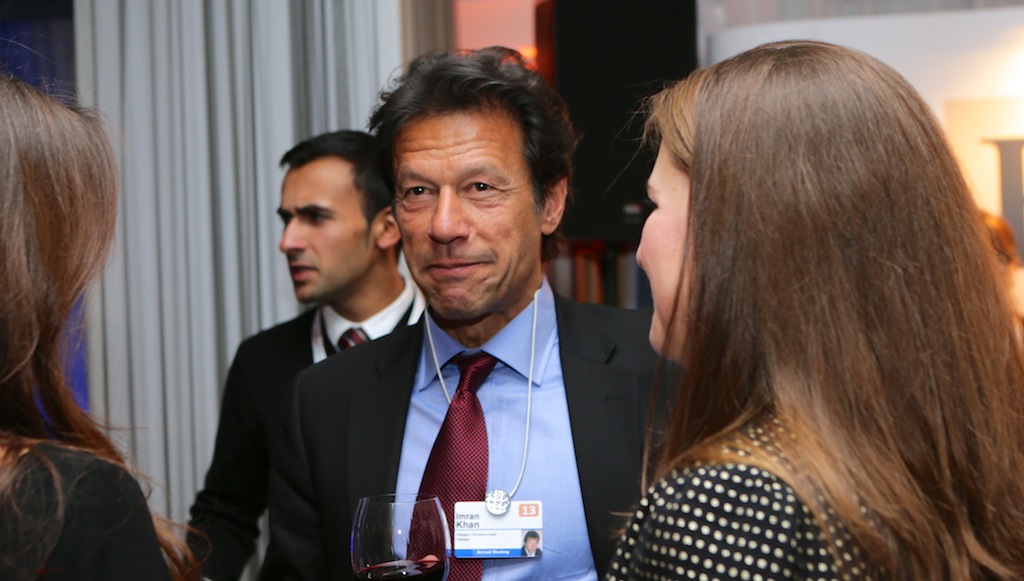
Image Credit: Imran Khan, Chairman of Pakistan Tehreek-e-Insaf (PTI). Photo via Wikimedia Commons, CC BY 2.0.
By Muhammad Younus, Universitas Muhammadiyah Yogyakarta and Imron Sohsan, Kaen University
Background
This research suggests that as the upcoming 2024 Pakistani elections loom on the horizon, online political campaigning has irreversibly migrated to center stage and become a focal point of contention in the country's political landscape. This phenomenon is most evident in emerging democracies, such as Pakistan, a country with an established online culture and an internet user base of approximately 111 million users as of early 2024, which provides fertile ground for political arguments and discussions. This widespread digital access presents political campaigns with unprecedented potential for dialogue, mobilization, and fundraising, which later significantly influences the country's political landscape. Specifically noteworthy, with the ever-growing ranks of young Pakistanis becoming increasingly tech-savvy, online campaigning promises to be a determining factor in influencing the electorate and ultimately shaping the outcomes of the 2024 elections. However, against such enormous potential, the Introduction critically raises genuine concerns regarding the misuse and unintended consequences of web campaigning. Specifically, disinformation, misinformation, and the spread of web hate speech are mentioned as capable of expanding existing social cleavages and of undermining democratic processes at their foundations. Moreover, the common problem of differential access to technology and varying degrees of digital literacy skills is on the verge of creating a vital information gap that may disenfranchise specific groups of people. Made aware of this complex reality, the study addresses a critical lacuna regarding the technical subtleties of digital political marketing campaigning in the backdrop of Pakistan's forthcoming 2024 elections.
The urgent call is to critically examine the strategies and tactics political agents implement in their digital marketing campaigns, including their extensive examination of social media platforms and messaging applications systematically study the influence of these campaigns on the attitudes, behavior, and decision processes of voters; carefully balance the potential challenges and ill effects resulting from the dissemination of misinformation, disinformation, and cyber hate speech and their far-reaching impacts to electoral integrity and social cohesion; and lastly identify and suggest best practices and recommendations for effective and responsible digital marketing campaigning, providing insightful lessons to stakeholders on maximally exploiting digital tools while minimizing associated risks. The research is therefore targeted at conducting an in-depth case study to present a rich and nuanced picture, which facilitates the detection of significant trends, strategies, and challenges to Pakistan's political landscape. The overall objectives are to examine internet campaigns by dominant political parties, monitor their impact on voter turnout, identify and evaluate associated risks such as disinformation, and generate recommendations for promoting responsible campaigning. In conducting this analysis, we provide a close examination of the online campaign utilized by the Pakistan Tehreek-e-Insaf (PTI) party, which identifies its innovative and sometimes controversial methods employed during the elections. PTI was reported to be amongst the most active utilizers of Twitter Spaces within the world of political parties, with one such prestigious session featuring Chairman Imran Khan as the speaker, earning a vast audience of over 165,000 listeners.
Digital Political Marketing Strategies
PTI effectively utilized the platform to organize and activate its supporters, particularly at critical moments, such as the Jalsa rally in Lahore in April 2022, thereby maximizing voter turnout and energizing its party base. Furthermore, Khan employed Twitter Spaces to engage with the masses, providing direct responses and sharing his opinions on current issues to build trust and rapport. Critically, the platform enabled PTI to bypass the conventional media landscape easily, going directly to the people and bypassing the traditional media outlets, especially where the party sensed a potential bias against its interests by the media. However, relying on live audio chats has the magnitude of risk and inherent challenge of preserving control over the message, with the dissemination of misinformation posing a significant threat. As a strategic retaliation to the arrest of their leader and alleged government intervention in mass gatherings and access to electronic media, PTI shifted to holding virtual rallies in an attempt to connect with their constituents. The rally featured an AI-generated speech of Imran Khan, produced from shorthand notes he sent from prison through his lawyers. The party claimed that the rally was a huge success, drawing millions of viewers on several online platforms. However, allegations were leveled against the party for possibly using AI technology to spread disinformation. The argument was made that virtual rallies were actually less efficient in engaging prospective voters who do not have internet access.
Taking their creative and digital strategy to the next level, especially after the party lost its initial election symbol, the 'bat,' PTI came up with a new and creative idea: utilizing a Facebook Chatbot on Imran Khan's official page. This chatbot was designed to enable voters to familiarize themselves with the nominated candidate and their new voting symbol by simply sending a message containing their constituency number, which the messaging bot was programmed to respond to within seconds. The response included the candidate's key details along with a convenient link that redirected the user to a public PTI WhatsApp channel specifically designed for sharing more constituency-related information. The deployment of an Imran Khan voice clone to post a convincing and powerful speech on various social media platforms, generated using the innovative new ElevenLabs platform from vocal snippets, was a hugely controversial and groundbreaking move. This latest development has raised significant ethical and legal concerns, as critics claim that this technological advancement can deceive and mislead voters at the ballot box with false or misleading information, thereby undermining democratic values and electoral integrity.
Its proponents, however, viewed it as a genuinely innovative and pioneering way of genuinely interacting with the electorate, even in the face of an inhibition placed on the leader under law. While the AI voice may have inflamed and energized loyalists, it may have also driven away some segments of the voters who were disappointed by the robotic quality of Khan's voice. Moreover, the research highlights the use of Virtual Private Networks (VPNs) by PTI supporters to circumvent state-imposed internet shutdowns and social media shutdowns, particularly during anti-government protests and those initiated by the Pakistani government. The use of VPNs, which is the general modus operandi in nations with a censorship regime, raises serious questions about the sustainability of freedom of expression in Pakistan and points to the fact that the party is facing government censorship.
The government's attempt to censor the internet is a violation of human rights, and the use of VPNs reflects a consistent effort to ensure free expression in the country. Finally, the study outlines the launch of a confirmed PTI WhatsApp Channel in 2023 as a strategic move to reach potential voters. The channel's primary objectives were to directly engage with the public and counter the propaganda of opposition political parties. It succeeded in conveying messages about policies, airing events, and sharing positive news about Imran Khan's achievements as an essential mobilization tool; however, experts caution that WhatsApp is vulnerable to being misused to spread fake news and disinformation, thereby undermining the integrity of the democratic process. The findings, therefore, provide an in-depth understanding of how a central political leader in Pakistan utilized a multifaceted, highly sophisticated, and sometimes controversial online campaign movement to navigate a complex and repressive political environment in the lead-up to the 2024 general elections.
Broad Regional Perspective
Although this study is situated in Pakistan’s 2024 General Elections, its analytical relevance extends directly to Southeast Asia, where many countries exhibit comparable political, technological, and institutional characteristics. Similar to Pakistan, several Southeast Asian democracies—including Indonesia, the Philippines, Malaysia, and Thailand—are marked by high social media penetration, youthful and digitally literate populations, polarized political competition, and recurring tensions between state authority and online political expression. The strategic use of live audio platforms, AI-generated political content, chatbots, and encrypted messaging observed in this case mirrors emerging campaign practices across the region, particularly in Indonesia’s national elections and the Philippines’ data-driven political marketing landscape. At the same time, the ethical risks identified—such as misinformation amplification, unequal digital access, algorithmic manipulation, and state-led internet restrictions—resonate strongly with Southeast Asian experiences of election-related content moderation, online surveillance, and temporary network disruptions. By positioning Pakistan as a comparative case, the findings contribute to a broader Southeast Asian discourse on how digital political marketing can simultaneously strengthen political participation while posing significant challenges to democratic accountability and electoral integrity.
In Indonesia, for example, political parties and candidates in the 2019 and 2024 elections extensively utilized WhatsApp groups, volunteer-based social media “buzzers,” and micro-targeted messaging to mobilize voters, often raising concerns about disinformation and coordinated online manipulation. Similarly, the Philippines has witnessed sophisticated data-driven political campaigning, where Facebook, TikTok, and influencer networks played a decisive role in shaping electoral narratives during the 2016 and 2022 presidential elections. Malaysia’s 2018 and 2022 general elections further illustrate how opposition actors leveraged digital platforms to bypass mainstream media constraints, echoing PTI’s reliance on Twitter Spaces and virtual rallies to circumvent perceived media bias. At the same time, Southeast Asian governments—such as Myanmar during the 2021 political crisis and Indonesia during periods of unrest—have implemented internet slowdowns or platform restrictions, similar to Pakistan’s election-period shutdowns, which prompted voters and activists to rely on VPNs. These regional parallels underscore shared governance challenges, particularly in regulating AI-generated political content, ensuring equitable digital access, and safeguarding electoral integrity without curtailing freedom of expression. Consequently, this study offers Southeast Asian policymakers and electoral authorities empirically grounded lessons on balancing innovation in digital campaigning with ethical oversight, transparency, and democratic accountability in increasingly digitized electoral environments.
Closing Remarks
In conclusion, this study argues that digital electoral influence, while expanding the reach and efficiency of political communication, currently poses greater risks than benefits in emerging and hybrid democracies when deployed without robust institutional safeguards. The Pakistani case demonstrates that digitally mediated campaigning—particularly through AI-generated content, live audio platforms, and encrypted messaging—can intensify political participation and mobilization, yet simultaneously amplify misinformation, erode trust in electoral processes, and exacerbate existing social and digital inequalities. These dynamics are not unique to Pakistan but resonate strongly across Southeast Asia, where weak regulatory frameworks, uneven digital literacy, and politicized media environments often allow technological innovation to outpace democratic oversight. Consequently, rather than inherently strengthening democracy, electoral influence driven by unregulated digital tools risks undermining electoral integrity and public confidence. This study, therefore, takes the position that digital electoral influence becomes democratically constructive only when embedded within clear legal frameworks, transparent platform governance, and sustained investments in digital literacy—without which its harms are likely to outweigh its democratic promise.

Muhammad Younus is a doctoral researcher in Government Science at Universitas Muhammadiyah Yogyakarta (UMY), Indonesia, with a background in Computer Science and Public Administration. His work focuses on digital governance, citizen participation, and sustainable public service innovation across Southeast and South Asia. He has authored over 60 international publications.

Sohsan is a lecturer at Khon Kaen University, Thailand, and holds a PhD in Social Science and Public Policy from Auckland University of Technology, New Zealand. He has 23 publications to his name and is involved in discussions regarding organizational restructuring and e-budgeting within local governments. Imron has participated as a speaker in international forums focused on decolonization and collaborative academic efforts.
In "Lebanon's chronic blackout issue is not just an engineering...
This article asks whether Indonesia is showing early symptoms of...
This article documents the systematic repression of Pan-African activists, journalists,...
This article looks at how Pakistan's 2024 General Elections were...
This article examines the tragic death of a child in...
This article examines poverty alleviation efforts in Kebumen Regency, Central...
This article critically examines Indonesia’s Makan Bergizi Gratis (MBG) programme,...
This article examines the socio-political impact of Pandji Pragiwaksono’s stand-up...
This article examines the persistent "political masculinity" in Indonesia, 41...
This article examines why Islamic political parties in Indonesia remain...
This article examines the global rise of school meal programs,...
This article examines Dhurandhar not merely as a commercial Bollywood...
This article highlight the development of IT that has been...
This article explores how Afghan women are using social commerce...
This article examines how youth-led, digitally networked movements are reshaping...
This article examines proposals to privatize religion not as neutral...
This article traces how a tense India-Pakistan cricket game, complete...
This article explains how the Pakistan-Saudi Arabia Strategic Mutual Defence...
This article examines how Afghan women have transformed the struggle...
This article explores how special autonomy in Aceh and Bangsamoro...
This article examines how Malaysia’s political economy sustains social harmony...
This article critiques the Global Innovation Index (GII) for overlooking...
This article examines how technology has become a highly contested...
This article takes a deep dive into Indonesia’s evolving struggle...








.jpg)
Leave A Comment