
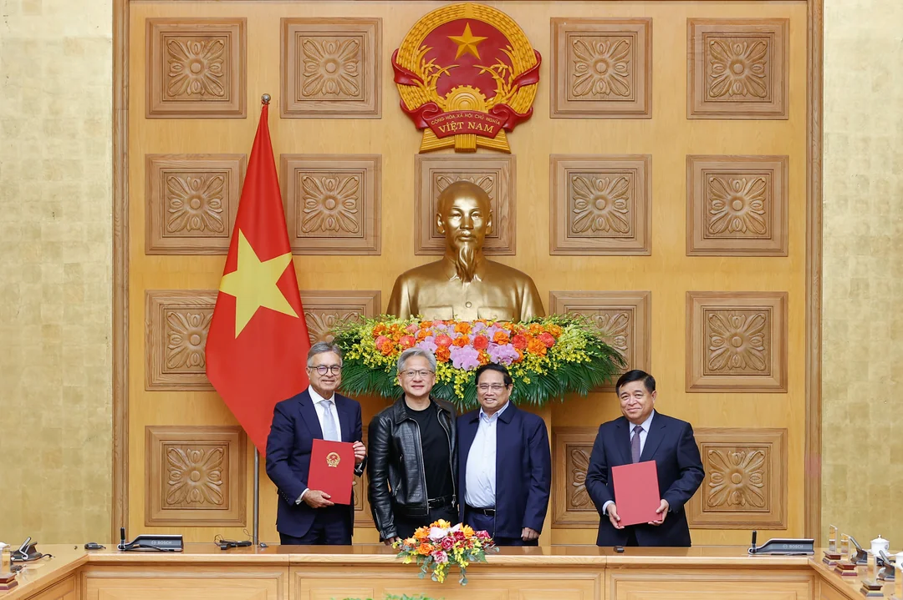
Caption: Vietnamese Prime Minister Pham Minh Chinh (second right), Minister of Planning and Investment Nguyen Chi Dung (right), and NVIDIA President & CEO Jensen Huang at the signing ceremony establishing an AI research and development center in Ha Noi on December 5, 2024.
Note: This image is used for educational, non-commercial purposes under fair use principles. All rights belong to the Viet Nam Government Portal (VGP).
Private AI corporations, rather than states alone, are increasingly the decisive actors in the global technology race, and their growing power poses a serious challenge to peace and stability in Southeast Asia. These firms control essential AI infrastructure, shape the pace and direction of technological development, and increasingly influence how AI is used in everyday life and in strategic competition. Stock prices of AI-related firms have risen significantly, and the founders of AI companies have become new tech celebrities, such as the leaders of OpenAI, Anthropic, Gemini, Grok, and Palantir, followed by chip giant NVIDIA led by Jensen Huang. Most of these companies are based in the United States, reinforcing the perception of US dominance in the global technology sector.
An interesting development is that, even as the United States adopts an aggressive international trade policy, including restrictions on AI models and chip exports, China continues to challenge this dominance. It does so by releasing open-source models such as DeepSeek and by developing cheaper semiconductor and chip industries to gain a competitive edge in this sector. This dynamic is creating a new arena for strategic competition between the two major powers.
However, the most crucial and decisive actors in this sector are business actors. The development of AI is primarily driven by private companies. They design the models and own most of the necessary infrastructure. States largely play a facilitating role in this process and use these technologies to pursue their national interests. At the recent AI India Summit, the CEOs of Anthropic and OpenAI reportedly declined to hold hands (CNBC, 2026), and afterwards Anthropic publicly rejected a US government proposal related to the use of AI for military purposes, especially for mass surveillance and autonomous weapons(CNN, 2026).
Meanwhile, Palantir openly prides itself on supporting Israel’s military operations in Gaza, which many observers like Lewis Backon (McDonald in Middleeasteye.net, 2026), and others (Raiss, 2024; Magee, 2026) describe as genocidal toward the Palestinian people. Alex Karp, Palantir CEO, in public discussions about AI, has repeatedly expressed pride in helping the US and Israeli militaries through Palantir’s technology and does not hide his alignment with US and Israeli strategic agendas. These examples illustrate two contrasting attitudes toward AI use. On the one hand, companies that at least claim to oppose the militarization of AI that undermines peace. On the other hand, actors that take a pragmatic approach, seeking to increase their value by selling their technologies to any buyer whose agenda aligns with their own values and interests.
If there is no effective regulation in this field, AI technologies could become instruments of massive destruction, available to any power able to purchase or contract them. The damage would not only be physical but also cultural, particularly for nations targeted by such tools. The world is already in turmoil following the escalation of conflict between the Israel–US axis and Iran, especially after previous peace arrangements collapsed. Tensions have intensified further since Houthi forces blocked the Bab el-Mandeb Strait (Gulfnews.com, 2026), threatening global energy supplies.
Today, multinational companies are at the forefront of the global AI race. States have little choice but to keep pace with these firms if they wish to maintain some control over AI development. With their vast access to data across multiple sectors, AI companies could potentially steer state behaviour by shaping public sentiment and influencing economic activities, given that many businesses now depend on AI tools to operate. Moreover, AI development involves cross-border data flows and thus affects both domestic stability and relations between states.
Multinational companies’ control over compute resources, chips, models, and cloud infrastructure (Beaumier and Cartwright, 2024; Hawkins, et.al, 2025), as well as their influence on AI standards and ethics (de Laat, 2021; Samaan, 2025), their role in data localization and export controls, primarily in the US, are all crucial factors for AI governance. At the same time, these factors also shape global stability, especially in the context of strategic competition between major powers.
It cannot be ignored that every company has its own values and its own investors, and that these values and interests influence the balance of power and geopolitics. For example, in the Israel–Palestine war, companies like Palantir and Amazon have clearly aligned with Israel because they have been contracted by Israeli institutions. Their involvement has real political consequences and makes neutrality practically impossible when their technologies are so influential.
Southeast Asia case
This dynamic is also visible in Southeast Asia, where US and Chinese interests collide. For years, US-based companies such as Google and Facebook dominated the digital ecosystem, but Chinese firms later gained a strong foothold in the region’s business environment. Companies like Alibaba and various Chinese manufacturers flooded Southeast Asian markets with Chinese products and platforms. However, contestation over AI in the region is more complex than the earlier penetration of China’s Belt and Road Initiative
In 2025, Southeast Asia experienced its first border crisis that become armed conflict after 1998 financial crisis. One of the triggers was the proliferation of online gambling and scam centres along the Thailand–Cambodia border (Dickson and Quitzon, 2026), whose operations had harmful spillover effects across the region and relied heavily on digital technologies to exploit victims. After the conflict ended, many of these centres were dismantled, and their role as a contributing factor to the war became clearer. This episode shows that digital technologies can act as catalysts for interstate conflict in the region.
At the same time, AI development is still relatively new in Southeast Asia, and it could generate either enormous opportunities or severe conflicts. ASEAN needs to strengthen its cohesion to prevent harmful consequences of AI deployment. One potential risk is the over-extraction of natural resources, especially water resources and critical minerals that needed to support AI infrastructure, which could damage the environment, disrupt social structures, and undermine stability if not managed wisely.
A second major concern is data security. Recent debates about advanced AI models, such as those developed by ChatGPT 5.6Sol and Claude 5 have raised fears about systems that become increasingly autonomous, exploit cybersecurity vulnerabilities, and potentially generate chaos if they cannot be properly controlled. Such systems might also expose sensitive information and scandals related to disputes or tensions among states in the region.
Therefore, AI companies could become one of the greatest threats to regional peace and stability if they are not regulated fairly and managed wisely. Southeast Asia currently functions more as a market than as a producer in the global AI industry, but this does not mean that state sovereignty is irrelevant. Rather, it highlights how urgent it is for ASEAN and its member states to take concrete action in order to shape, guide, and, when necessary, restrain AI companies operating in the region.

Affabile Rifawan is a lecturer and researcher in the Department of International Relations, Universitas Padjadjaran, Indonesia, with research focus on global political economy, He is also a speaker for “Indonesia’s transformation: from foreign policy to economy and business” in the light of Hungarian and Indonesian relations Forum" at Mathias Corvinus Collegium, Budapest, Hungary on the panel "Trade, business and investment in bilateral relations" in September 2024 and also one of Indonesia's delegates at AUS4ASEAN Fellowship: Digital Trade and Digital Inclusive Economy at University of Melbourne in June-July 2025.
In this article, Affabile Rifawan examines the shifting landscape of...
This article examines how Indonesia’s nickel downstreaming policy has driven...
This article examines the "permission economy" in Pakistan, an informal...
This article examines how the illicit smuggling of critical minerals...
This article argues that poverty and uneven development in the...
This article explores how the Global South is reevaluating its...
This article examines the challenging path for Indonesia to meet...
This article analyzes Nigeria’s attempt to convert carbon credits into...
This article examines how Indonesia’s MBG program, while reaching more...
This article critically analyzes the 17th BRICS Summit communique, highlighting...
This article explores what Indonesia’s upcoming Digital Rupiah can learn...
This article explores how Indonesia can transform its steady economic...
This article discusses how global ESG standards, mainly created within...
This article explores Indonesia’s resilient people-based economy, driven by 65...
This article examines Indonesia’s 2025 economic turmoil, marked by a...
This piece explores how Pakistan can harness its rich cultural...
This incisive piece unpacks the deeper logic behind Trump’s so-called...
This article introduces Sustainable Prosperity Investing (SPI) as a hybrid...
This article examines how globalization challenges the authority of Islamic...
This article examines Danantara, Indonesia’s recently launched sovereign wealth fund...
This article explores how digital payment systems are reshaping financial...
This article explores the expansion of Islamic banking beyond Muslim-majority...
This article examines the impact of Trump’s aid cuts on...
Nestled within the Singapore-Johor-Riau Growth Triangle, Bintan Island has quietly...








Leave A Comment