
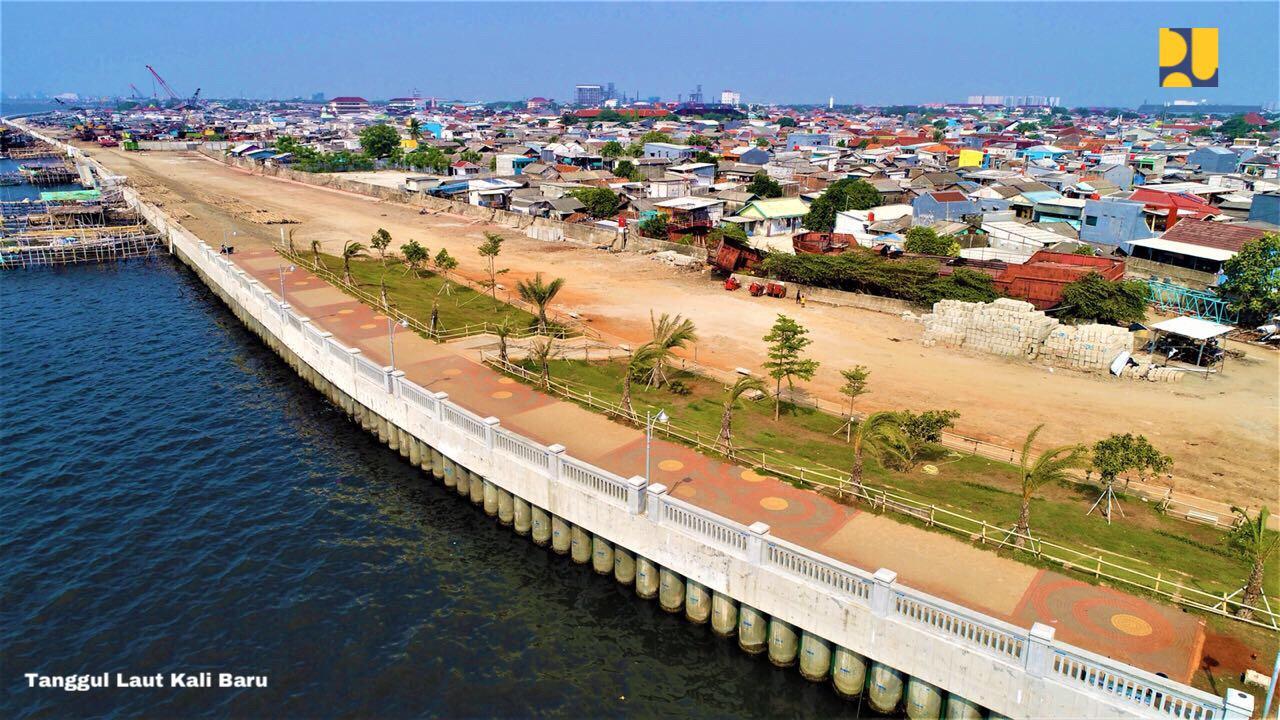
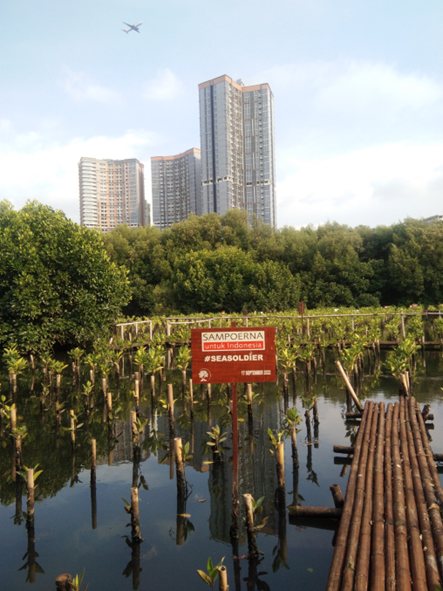
Image Credit: The Muara Baru sea wall project, North Jakarta. Indonesian Ministry of Public Works and Housing
In the Pluit neighborhood of North Jakarta, the ground sinks rain or shine, not dramatically not all at once but steadily, quietly, a few centimeters every year, the decades of uncontrolled groundwater extraction leaving behind nothing but a shell of earth beneath one of the world's densest coastlines. In some places the sea wall that keeps the Java Sea at bay is already below the level it was built to withstand. This is not a problem for the future. It is the problem of today. And Indonesia's answer, after years of deliberation, was to build a gleaming new capital in Kalimantan Timur and call it Vision.
The Indonesian government had already spent Rp 75.8 trillion (nearly US$4.7 billion) between 2022 and 2024 on Nusantara, while Jakarta's Giant Sea Wall, which was to protect North Jakarta from permanent inundation, was already late by a number of years by 2024 and not scheduled for completion until 2030 or later. Officially, the reason given by Jakarta's own water resources agency is budget availability. Last year president Prabowo asked Jakarta city to contribute half toward the remaining cost, because - and this is a direct quote - "this project is actually for Jakarta". The reasoning seems to be, that the ten million people left behind should also pay for their own protection.
But this is not a failure of foresight. As the political scientist James Scott noted in Seeing Like a State, governments are drawn to projects that are legible, mappable, and celebratable. The construction of a new capital has architectural renders, ribbon-cutting ceremonies, and presidential inauguration footage. The remediation of the groundwater extraction that is literally dissolving the foundations of North Jakarta- the hotels, factories, and residential developers that have pumped it illegally for the last three decades- has absolutely none of that. This has only the slow, unglamorous work of enforcement, lawsuits, and powerful landowners who would prefer the problem stay invisible. Nusantara requires contracts. And contracts in Indonesia, as anyone who has watched its procurement cycles knows, have a way of finding the right recipients.
The cruelest part is the question of who gains and who does not. The civil servants who will eventually relocate to Kalimantan will get planned infrastructure, green corridors, and modern offices. The fishing families along the Pantura coast, the kampung residents of Penjaringan, the women vendors in Muara Baru whose stalls flood four months a year - they gain a national government that has physically moved further from their problem. Amartya Sen built his life's work around the argument that development must be measured not by what the state builds, but by what actual people are actually able to do and be. By that measure, the people getting better lives out of this arrangement are not the ones whose floors are underwater. Development that does not reach the people sinking is not development. It is escape with a national emblem on it.
The problem is not mysterious: groundwater over-extraction has been nominally regulated in Jakarta for years and effectively regulated almost never. Of the planned 28.2 kilometers (17.5 mi) of coastal sea wall, only 11.8 km (7.3 mi) had been built. These are not failures of knowledge or engineering; they are failures of political will - the kind of failure Douglass North studied for a career: institutions captured by powerful interests over decades do not reform themselves simply because a crisis becomes undeniable. They have adapted around the crisis before; moving the capital would not break that pattern. It is the pattern completing itself -the original problem left fully intact, now without the daily pressure of the national government being physically present in the city it has failed.
That said, while Java's overcentralisation is a real structural problem, and Nusantara's promise to redistribute economic activity across the archipelago is worth considering, the decline of Jakarta didn't begin with this administration. There was a century's worth of colonial-era infrastructure, and then four decades of urban sprawl since Suharto's New Order came to power. It was obvious that the city would eventually buckle beneath its own weight. These are good points, but they still do not answer the question we keep asking: who is responsible for maintaining the sea wall? Which ministry is responsible for the groundwater crisis? Whose desk does it sit on when the people who built careers in Jakarta have migrated to Borneo? Moving government is not the same as fixing governance. Indonesia has spent decades showing that the problem was never the address.
There is one thing the government could do, starting now, that would signal it is not simply abandoning the ten million people it is leaving behind. That is regulating groundwater pumping with some serious teeth. The regulatory architecture already exists: Gubernatorial Regulation No. 93 of 2021 banned groundwater extraction in buildings over eight floors or 5,000 square metres from August 2023, and Governor Pramono strengthened that framework in February 2026 with Pergub No. 5, extending the prohibition to industrial zones and major business districts. Yet environmental groups noted almost immediately that enforcement remained minimal. The structural reason is straightforward: PAM Jaya's piped water network still only covers around 70 percent of the city, meaning a blanket ban pushes commercial users toward non-compliance rather than alternatives. Not another task force. Instead of more inter-ministerial MoUs, the tools already exist under Government Regulation PP No. 121/2015 on Water Resources and the Water Resources Law: fines, licenses revoked, and developers prosecuted, to deal with commercial users - hotels, factories, and residential towers - who account for most of the illegal extraction in North Jakarta. The government needs to fund PAM Jaya's coverage expansion and enforce the ban simultaneously, not sequentially. It would not be glamorous. It would not photograph well. But it would slow the sinking. And it would prove that the government still considers governing Jakarta part of its job description.
Pluit is still sinking, and putting the new capital three islands over does not change the physics of that. Only a government willing to stay and govern the city it already has - with all the political difficulty that involves - can.

Sahar Manzoor is a Social Sciences graduate and gold medalist from Pakistan. She a is currently pursuing Master of Public Policy (MPP) with a specialization in Climate Change at Universitas Islam Internasional Indonesia (UIII). Her academic interests focus on climate governance, social equity, and sustainable policymaking.
This article examines how the systemic failure of urban waste...
Indonesia is spending Rp 75.8 trillion (around US$4.7 billion) building...
This article analyzes climate vulnerability across Economic Community of West...
This article argues that addressing climate change in the Global...
This article examines Indonesia’s transition from reactive emergency disaster spending...
This article examines the DRC–Rwanda peace accord through the lens...
This article offers a comparative reflection on how Islam has...
This article examines how youth-led, digitally networked movements are reshaping...
This article examines why forest-based approaches remain critical for addressing...
This article exposes the injustice of Afghanistan’s exclusion from COP30...
This article highlights the significant emotional and mental health burden...
This article defines Code Green as a model of public...
This article analyzes how China’s ambitious green transition serves not...
This article traces how the 2025 UN General Assembly turned...
This article looks at how Indonesia’s provinces with extensive biodiversity...
This article examines how climate change and privatization intersect to...
This article analyzes how Trump’s second time withdrawal from the...
This article critically analyses Pakistan’s worst floods ranging from the...
This article examines the climate vulnerabilities of Pari Island in...
This article traces how Pari Island in Jakarta’s Thousand Islands...
This article explores how ecotourism in Indonesia’s Thousand Islands generates...
This article compares how U.S. Presidents Joe Biden and Donald...
This article explores the devastating impact of human activities such...
This article critically examines the European Union’s Carbon Border Adjustment...











Leave A Comment