
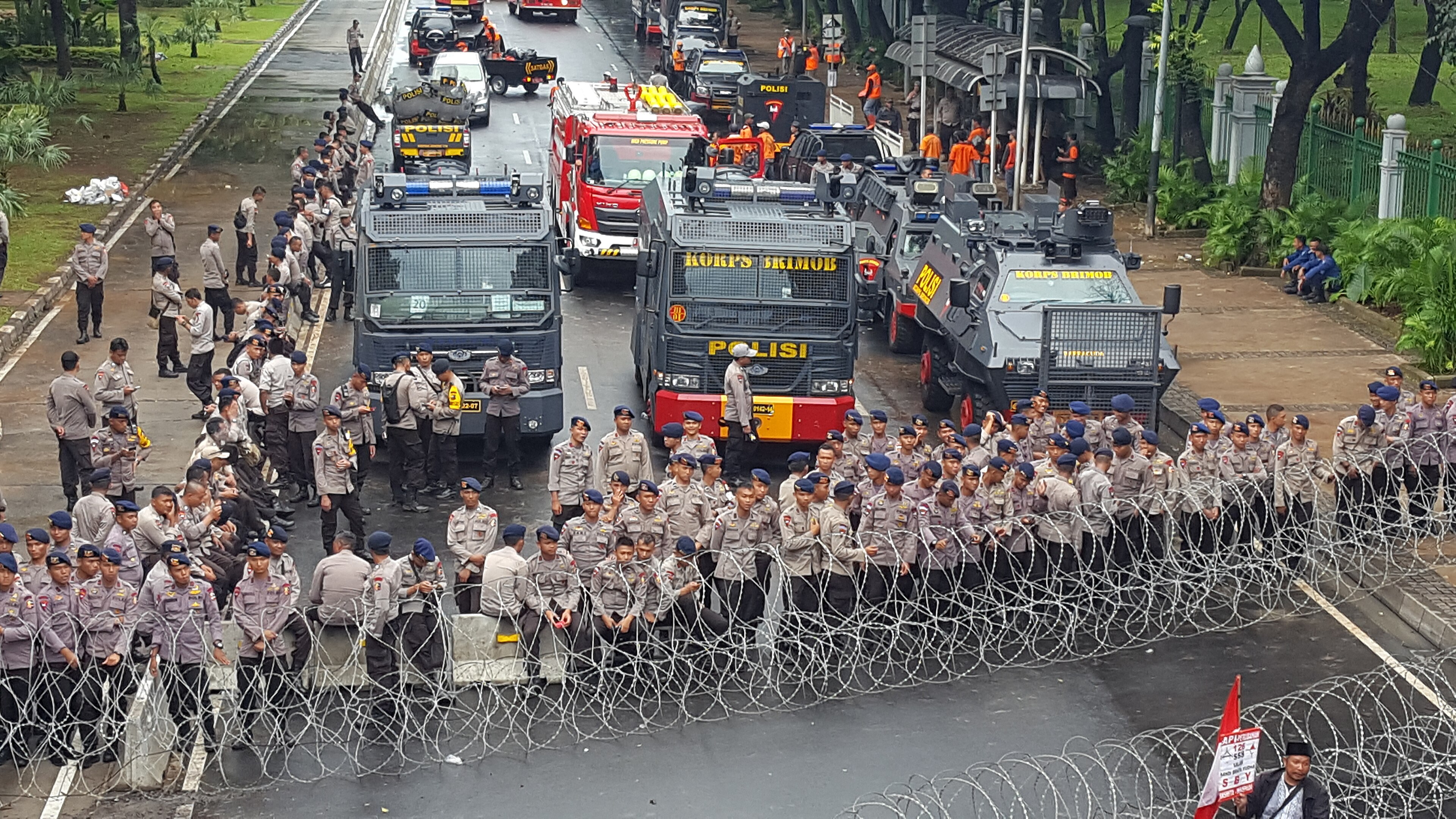
Image Credit: "Indonesian mobile brigade riot police" by AWG97, via Wikimedia Commons, used under CC BY-SA 4.0.
The state of human rights and the pillars of democracy in Indonesia is currently facing one of its most critical periods. According to the 2026 Freedom in the World report published by Freedom House, Indonesia is now classified as "Partly Free" with a score of 56 out of 100. In line with this, CIVICUS Monitor has categorized Indonesia’s civic space as “obstructed” and placed the country on its watch list as of July 2025 due to a massive and significant deterioration in the state of civic space.
This grim record was underscored by a series of dangerous incidents targeting human rights defenders throughout 2025. A total of 295 human rights defenders were reportedly attacked, and a wave of protests in August 2025 led to the arbitrary arrest of more than 6,700 citizens and claimed at least 13 lives. In addition to social unrest, the ecological situation also deteriorated with a disaster in Sumatra that claimed 1,207 lives and displaced more than a million residents at its peak. These trends do not stand alone as a series of isolated events. They reflect an increasingly coherent pattern: the use of legal instruments to criminalize dissent; the deployment of security forces that exceeds the bounds of proportionality; the mobilization of nationalist sentiment to delegitimize the opposition, and the consolidation of power that has the potential to weaken checks and balances.
The facts and data above highlight the need to analyze this situation through a more incisive framework, one capable of capturing not only the methods of control but also the nature and trajectory of the regime as a whole. Some scholars have documented authoritarian tendencies in Indonesian politics; Sana Jaffrey and Eve Warburton place Indonesia "on the edge of competitive authoritarianism", while Tim Lindsey reports that Indonesian civil society leaders describe it as “New Order Volume II” or “neo-New Order.”
Are we witnessing the emergence of conditions that are gradually enabling fascism to take root? The question is posed here as an open hypothesis, tested against the dynamics of democracy, civil society, militarization, and the political economy of Indonesia today. Fascism is not an event that happens overnight. It is a gradual process in which the state increasingly combines political repression, aggressive nationalism, oligarchic economic power, and the weakening of democratic institutions until democracy is reduced to nothing more than an electoral procedure. Thus, what we seek to examine is not whether Indonesia has already become a fascist state, but rather whether there are trends moving in that direction, as revealed through an analysis of the following five arenas.
An increasingly repressive state
Restrictions on freedom of assembly and expression have now become one of the most pressing issues. For example, in the lead-up to Independence Day on August 17, 2025, a citizen-led initiative to fly pirate flags inspired by the anime One Piece, as a form of criticism, triggered a reactive and excessive response from the authorities. Many individuals have been targeted, flags have been confiscated from homes and vehicles, various murals have been removed, and the government has threatened legal sanctions against members of the public who follow this trend. This phenomenon clearly illustrates that citizens’ political expression, even when packaged as creative popular symbols, is still often viewed as a threat to the state.
Repressive measures against public protests also continued. A wave of large-scale demonstrations erupted in various regions in August 2025, sparked by public outrage over budget policies, the rising cost of living, and allowances for members of the House of Representatives. On August 28, an online motorcycle taxi driver lost his life after a Brimob tactical vehicle plowed into an area crowded with protesters. Throughout the series of protests, authorities reportedly used excessive force, including tear gas, water cannons, rubber bullets, beatings, and intimidation. More than 6,719 people were arrested, more than 703 political detainees were criminalized following the series of protests, and at least 13 people were reported dead.
Freedom of religion and belief also continues to face threats. In July 2025, an attack occurred against worship and religious education activities at the Jemaat Anugerah Padang house of prayer, part of the Setia Indonesia Christian Church, in Koto Tangah, Padang. The attackers disrupted the activities, damaged the building and facilities, and injured two children aged eight and eleven. Previously, in late June 2025, a Christian youth retreat in Cidahu, Sukabumi, was also attacked following allegations that Christian worship services were being held at a private villa. These incidents highlight the state’s inadequate protection of religious minority groups and their places of worship.
On the other hand, indigenous peoples and local communities continue to face pressure from extractive and development projects. In South Papua, the Merauke Food Estate project has impacted more than 50,000 indigenous people and is being carried out without free, prior, and adequately informed consent. In East Halmahera, the Maba Sangaji indigenous community, which opposes nickel mining activities, faces criminalization. In May 2025, eleven residents were detained following a traditional ritual held as a form of protest, and in October they were sentenced to prison before finally being released at the end of the year.
Furthermore, amid discussions about forming an assessment team that could potentially shift the state’s role from protector to arbiter of legitimacy for human rights defenders, Indonesia faces a similar risk: a shrinking civic space driven by legal instruments and stigma, while civil society organizations must consider survival strategies, whether operating from within, from outside, or somewhere in between.
Overall, these conditions demonstrate that the shrinking of civic space, impunity, discrimination, the criminalization of citizens, and weak protections for vulnerable groups remain the primary patterns of human rights violations in Indonesia.
The rule of law under the threat of arms
A real test of the logic of the rule of law took place openly in the early hours of July 9, 2026. Dozens of properties linked to Febrie Adriansyah, the Deputy Attorney General for Special Crimes, were raided and searched by the Corruption Eradication Corps (Kortastipikor) of the Jakarta Metropolitan Police.
Following the search, instead of following standard legal procedures such as processing the crime scene or filing a pretrial motion, the steps taken were highly unusual. Within just a matter of hours, dozens of soldiers in full combat gear appeared outside Febrie’s private residence in South Jakarta. TNI headquarters has confirmed that deployment, describing it as routine protection requested by the Attorney General’s Office. Tempo also reported that military personnel went to the Jakarta Metro Police Headquarters, where Indonesia Police Watch says two brigadier generals sought the return of seized evidence, which included hundreds of billions of rupiah in cash in various currencies and 74 kilograms of gold, as well as the release of a suspect then in police custody. TNI has denied that any soldiers went to the police over this matter. Even on the facts TNI does confirm, the episode lays bare the complex web of power dynamics in the enforcement of the rule of law in Indonesia.
Although the Indonesian National Army (TNI) headquarters has denied it, this incident has sparked concerns about the remilitarization of law enforcement in Indonesia, a country that has been striving to consolidate its democracy since the fall of the authoritarian regime in 1998. Indonesian democracy was built on the promise that the military would return to its barracks and focus on defense, while civilian authorities would control policy and law enforcement. However, the current situation is putting that promise to the test. The military’s protection of Febrie’s residence, and the reported presence of troops at the police station, point to military involvement in non-military affairs with serious implications, namely corruption and human rights violations.
Escalation of conflict between Indonesian security forces and Papuan armed groups threatens the safety of civilians, particularly indigenous communities, and fuels human rights violations, restrictions on civil liberties, and repression against human rights defenders and nonviolent political activists. Furthermore, the food estate projects in Merauke, Boven Digoel, and Mappi have drawn criticism regarding their impact on the rights of indigenous peoples and environmental protection, as documented in films such as Pesta Babi. In this context, Papua serves as a crucial lens through which to examine how the state responds to conflict, manages resources, and addresses the demands of society in Indonesia today.
Structural economic inequality, aggressive nationalism, and the cult of personality
CELIOS released a report revealing the reality behind the narrative of economic growth: the wealth of Indonesia’s 50 richest people is equivalent to that of 55 million poor Indonesians. A total of 57.8% of their wealth comes from extractive sectors such as coal, palm oil, and nickel. The wealth of the oligarchy increases by an average of 13 billion rupiah per day, while workers’ wages rise by only about 2,000 rupiah per day. Indonesia currently ranks among the countries with the highest levels of inequality: the top 10% of the population receives 46% of total income, while the bottom 50% receives only 14%. This inequality is not a natural phenomenon; rather, it has accumulated systematically and is reproduced across generations. Therefore, the issue lies not only in the distribution of wealth but also in how the concentration of economic resources can influence the distribution of power, access to decision-making, and the direction of public policy.
These findings are even more concerning when considered in light of how Indonesian youth view the current economic situation. The 2024 ISEAS Survey shows that 67.3% of Indonesian youth consider income distribution in their country to be “unfair” or “very unfair,” the highest percentage among the six Southeast Asian countries surveyed. Furthermore, this perception goes hand in hand with pessimism regarding Indonesia’s economic and political prospects, indicating that inequality is no longer viewed as merely an economic issue but has become a crisis of confidence in social justice and the direction of national development.
Ironically, this frustration is not solely caused by the low aspirations of the younger generation, but rather by structural issues, ranging from the dominance of informal work and the limited availability of quality jobs to the mismatch between the education system and the needs of the labor market. In other words, for many young Indonesians, social mobility through education and hard work is increasingly losing its promise.
In this context, economic inequality not only leads to poverty but also produces frustration, alienation, and a loss of trust in democratic institutions. History shows that such conditions often provide fertile ground for political systems that offer shortcuts through the figure of a “savior leader,” an aggressive form of nationalism that does not unite but rather breeds suspicion, instills fear, and demands unconditional loyalty to the state. President Prabowo and his supporters, both openly and implicitly, frequently express wariness toward outside influences, particularly toward NGOs or foreign-funded organizations, which are often labeled as foreign stooges or agents. More recently, Prabowo has also referred to journalists, experts, and NGOs critical of the government as Londo Ireng.
Another sign of aggressive nationalism is the attempt to control the historical narrative to perpetuate the legitimacy of those in power. The Ministry of Culture’s project to rewrite history, for example, includes only two of the 12 cases of gross human rights violations investigated by the National Commission on Human Rights. If left unchecked, this could lead to historical amnesia, in which the public remembers only the version sanctioned by the state and forgets the voices of the victims.
Furthermore, in recent times, the public sphere has been dominated by narratives that portray President Prabowo Subianto not merely as the head of government but as a problem-solver for nearly all of the nation’s challenges. The publication of the book Presiden Solusi: Problem Solving Ala Presiden Prabowo,accompanied by various testimonials from officials, government communication content, and the glorification of his leadership, demonstrates an effort to build the image of a leader who transcends his institutional role. What warrants attention is not the existence of the book itself, since many leaders write or have books written about themselves, but rather the political function played by this narrative: encouraging the belief that solutions to the nation’s problems depend on the capacity of a single individual, rather than on the strength of democratic institutions.
Political scientist Emilio Gentile refers to this phenomenon as the sacralization of politics, when politics is sanctified through the worship of a leader positioned as the savior of the nation. Meanwhile, Jason Stanley, in How Fascism Works, explains that fascist politics always requires a mythic leader: a figure constructed as extraordinary, capable of overcoming any crisis, transcending institutions, and even appearing to be the nation’s sole hope for the future. Under such conditions, criticism of policies gradually shifts to criticism of the leader as a person, and is ultimately perceived as a threat to the nation itself.
The beginning of a process of fascistization?
The question is not whether Indonesia has already become a fascist state, but rather whether an increasing number of symptoms traditionally associated with the process of fascistization are beginning to appear in our political life. The shrinking of civic space, the normalization of state violence, the expanding role of the military in civilian affairs, the increasing concentration of wealth in oligarchic hands, the rise of aggressive nationalism, and the tendency to build a cult of personality around leaders. These are not isolated events.
When these symptoms emerge simultaneously, the question is no longer whether each can be explained separately, but rather whether they are collectively forming a larger pattern. Thus, the erosion of freedom is rarely initiated by the sudden abolition of democracy. It more often unfolds through the normalization of various practices previously considered exceptional, such as the increasingly repressive use of power, the gradual erosion of institutions, the delegitimization of criticism, and the public’s growing acceptance of exceptions that eventually become political norms. The greatest danger lies not in a country officially declaring itself authoritarian, but in society ceasing to view these symptoms as cause for concern.
According to Robert Paxton, fascism is not an event that emerges suddenly but rather a political process that develops gradually. It more often manifests as an accumulation of compromises in the face of injustice: when state violence begins to be regarded as normal, when oligarchy becomes the foundation of public policy, when criticism is framed as a threat, and when democracy is maintained merely as a ritual held every five years without the accompanying freedoms.
Indonesia may not yet be a fascist state. However, history also teaches us that almost no society realizes it is sliding into fascism while the process is underway. Awareness usually comes too late, when institutions have been paralyzed, civic space has been shut down, and fear has become part of everyday language. The question is no longer whether we will call it fascism, but rather, if the various signs outlined in this article are indeed part of a process of fascistization, then our greatest challenge is not merely to recognize it, but to prevent it before it is too late.

Firda Amalia Putri is aResearch Assistant at the University of Amsterdam and Assistant Editor for Studia Islamika. In addition to her academic and professional work, she serves as a board member of Amnesty International Indonesia 2025-Now and has been actively involved in regional and global human rights forums since 2021.
In "Lebanon's chronic blackout issue is not just an engineering...
This article asks whether Indonesia is showing early symptoms of...
This article documents the systematic repression of Pan-African activists, journalists,...
This article looks at how Pakistan's 2024 General Elections were...
This article examines the tragic death of a child in...
This article examines poverty alleviation efforts in Kebumen Regency, Central...
This article critically examines Indonesia’s Makan Bergizi Gratis (MBG) programme,...
This article examines the socio-political impact of Pandji Pragiwaksono’s stand-up...
This article examines the persistent "political masculinity" in Indonesia, 41...
This article examines why Islamic political parties in Indonesia remain...
This article examines the global rise of school meal programs,...
This article examines Dhurandhar not merely as a commercial Bollywood...
This article highlight the development of IT that has been...
This article explores how Afghan women are using social commerce...
This article examines how youth-led, digitally networked movements are reshaping...
This article examines proposals to privatize religion not as neutral...
This article traces how a tense India-Pakistan cricket game, complete...
This article explains how the Pakistan-Saudi Arabia Strategic Mutual Defence...
This article examines how Afghan women have transformed the struggle...
This article explores how special autonomy in Aceh and Bangsamoro...
This article examines how Malaysia’s political economy sustains social harmony...
This article critiques the Global Innovation Index (GII) for overlooking...
This article examines how technology has become a highly contested...
This article takes a deep dive into Indonesia’s evolving struggle...






Leave A Comment