
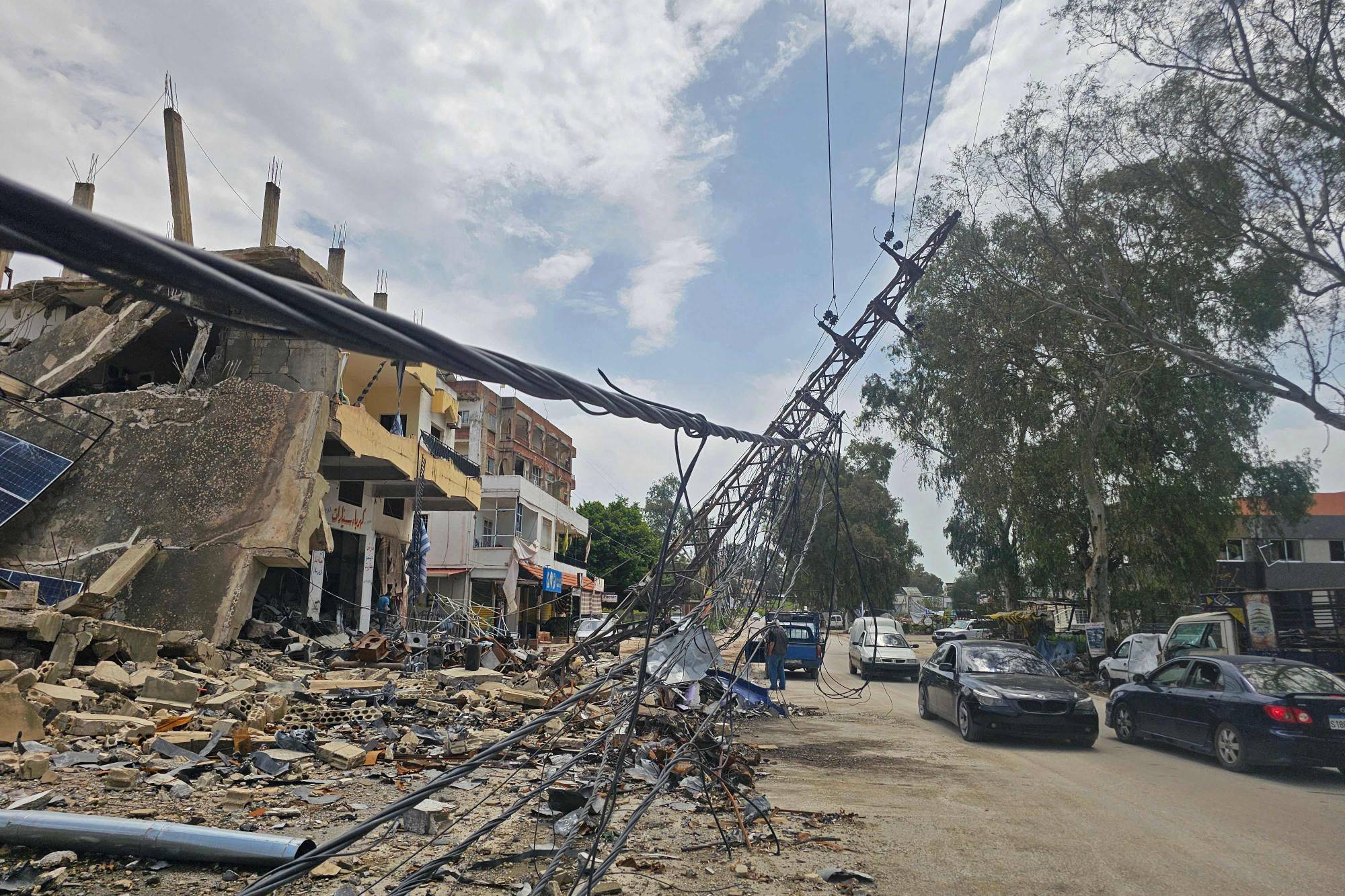
Damaged power infrastructure in southern Lebanon following the conflict, deepening the country’s long-running electricity crisis. AFP.
Lebanon's chronic blackout issue is not just an engineering failure or an unavoidable result of regional conflict. They are a deliberate product of political design. Physical destruction and financial losses highlight how the system fails its citizens. Since the spring of 2026, the southern part of Lebanon glows not just from the Mediterranean sun, but from the remnants of a conflict that has again wrecked fragile infrastructure. Preliminary estimates place physical damage to the power grid in the south and Nabatiyeh alone at 67.5 million dollars, excluding the transmission sector. Separately from physical damage, the utility suffers heavy collection losses, missing roughly 42.8 million dollars a month in uncollected bills, with about 30 million dollars traced to payment exemptions granted after the 2024 war.
Yet, for those living in Beirut or Tripoli, the total blackout is not news, but it has become a way of life. The government provides two to four hours of power per day. Lebanon has become a country where the state is a ghost and the generator mafia is the savior. People were told the crisis is technical or unavoidable due to regional wars. The history and politics of Lebanon's grid point to a more painful truth. The darkness is not a failure of engineering. It is a deliberate product of Lebanon's political institutions.
The Lebanese electricity crisis is a sign of two structural forces in the country, which are neopatrimonialism as a system where officials treat public office as private property for elite gain, and path dependency, where early historical decisions strictly constrain all future choices. The current paralysis is locked in by a sectarian power sharing agreement that prioritizes elite rent seeking over public service. To fix the lights, people must stop trying to fix a centralized state designed to fail its citizens. The country must move toward decentralization and clear, bottom-up solar incentives.
To understand why people cannot flip a switch now, we have to look back to 1920, because early institutional choices lock in future outcomes. The French Mandate did not just draw the borders for Lebanon; it established institutionalized sectarianism. While the 1926 constitution written under the Mandate introduced confessional distribution of public office in general terms, it was the unwritten 1943 National Pact at independence that specifically allocated the three top posts: a Maronite Christian president, a Sunni Muslim prime minister, and a Shia Muslim speaker of parliament. This created a system where every public utility became a cake to be sliced among the leaders.
This is why Électricité du Liban (EDL) is a financial black hole. As Human Rights Watch documents, government transfers to EDL contributed more than 40 billion dollars to the public debt between 1992 and 2018, with World Bank data showing that these annual subsidies regularly accounted for nearly half of the country's total fiscal deficit. In a healthy state, a utility that loses money undergoes reform. In a neopatrimonial state, officials use public office for personal gain and sectarian benefit. Fuel contracts and maintenance tenders reward loyalists; when a system serves the elite by being broken, there is no incentive to fix it.
Lebanese live under an extractive institution, one built to channel resources upward rather than deliver a service. The state maintains a monopoly it cannot fulfill. This forces citizens to pay double. They pay a symbolic bill to the government for power they do not get. Then they pay a massive, unregulated bill to private generator owners for the power they actually use.
These small scale generators are less efficient and far more expensive. Private generator operators charge roughly $0.34 per kWh, while Électricité du Liban sets its baseline state tariff at $0.10 per kWh. Citizens pay more than three times the official state rate for private power. Yet, generator operators represent a powerful lobby that benefits from state failure. This top down model is simply ignoring local needs. The shift of solar and gas is happening slowly because political leaders who benefit from the current situation block implementation.
States often over promise and become obsess over massive projects that ignore local reality. For decades, Lebanon chased a grand national grid while communities survived through some localized efforts. Électricité de Zahlé (EDZ) demonstrated the power of local management, running a generation and distribution model that kept Zahlé and surrounding villages supplied 24/7 for years while the rest of the country stumbled in the dark. EDZ has reached its limit in July 2021 when EDL fuel supply collapsed and diesel imports was mostly over, forcing EDZ into rationing. This failure shows how crucial insight is for microgrid resilience, as local distribution alone cannot survive if it remains at the same state and vulnerable fossil fuel supply chains as the central state does. True decentralization requires pairing local governance with a solution like an independent renewable generation.
Community led renewable initiatives show how to break that dependency. In the village of Toula, volunteers raised over $100,000, largely from expatriates, to install a 185 panel solar farm on church land to power the communal generator. Toula demonstrates that local initiatives can succeed where the state fails, provided they combine local ownership with solar infrastructure that operates independently instead of imported fuel that they are used to.
Policy has failed to support the shift as well. While the 2022 budget law explicitly exempted solar energy equipment from both the 11% Value Added Tax (VAT) and customs duties, execution fell apart in practice. As SurgePV reported, the tax relief just lasted only a few months in 2023 due to inconsistent implementation across customs ports. It made the importers once again face a 5% duty on finished solar panels under HS code 8541.40 alongside a 3% customs fee, and pay VAT on essential components like inverters and batteries. These combined charges add roughly 7% to the total cost of a system. If the state cannot provide power, it should stop taxing the citizens who provide it for themselves.
Policymakers must stop looking for a grand central fix. Reform must operate across specific levels:
The Ministry of Finance must issue a clear decree exempting all renewable energy components from the 11% VAT and all customs tariffs. Removing these financial barriers empowers individual households to secure their own power.
Lebanon must move beyond just having special cases like Zahlé by addressing why past attempts at market reform failed. Because on paper the Law 462 of 2002 already provided a roadmap to break Électricité du Liban's monopoly by unbundling generation and creating an independent Electricity Regulatory Authority (ERA). But political leaders blocked the ERA for over two decades because an independent regulator would strip sectarian patrons of their control over contracts and tenders. The parliament in lebanon passed the Distributed Renewable Energy Law or Law 318 of 2023, to permit local power trading, but without an operational, and autonomous regulator would make the implementation would stay stalled.
To break this cycle, parliament must pass clear legislation that delegates energy authority directly to municipalities and local private entities. Removing ministerial choke points ensures that local communities can build microgrids without waiting for a central authority designed to stall them.
The government should stop pouring money into the old centralized grid. It is too exposed to war and corruption. Money should go instead into microgrids that can run independently once the national system fails.
The electricity crisis in Lebanon is a tragedy of failed central planning. The state insists on maintaining a centralized monopoly, while people still face daily blackouts. Decades of having sectarian governance have deepened this operational failure. The rapid growth of individual solar systems shows that the public is ready to move past the failing central grid. So for this transition to succeed, policymakers must remove the regulatory bottlenecks and empower people's initiatives to pursue private energy. Maintaining rigid central control over a collapsed utility will only extend chronic blackouts and stall economic recovery.

Eslam Elsheikh is an MPP student specializing in climate change at Universitas Islam Internasional Indonesia. He focuses on economic behavior, public policy design, and regional development related to climate action.
In "Lebanon's chronic blackout issue is not just an engineering...
This article asks whether Indonesia is showing early symptoms of...
This article documents the systematic repression of Pan-African activists, journalists,...
This article looks at how Pakistan's 2024 General Elections were...
This article examines the tragic death of a child in...
This article examines poverty alleviation efforts in Kebumen Regency, Central...
This article critically examines Indonesia’s Makan Bergizi Gratis (MBG) programme,...
This article examines the socio-political impact of Pandji Pragiwaksono’s stand-up...
This article examines the persistent "political masculinity" in Indonesia, 41...
This article examines why Islamic political parties in Indonesia remain...
This article examines the global rise of school meal programs,...
This article examines Dhurandhar not merely as a commercial Bollywood...
This article highlight the development of IT that has been...
This article explores how Afghan women are using social commerce...
This article examines how youth-led, digitally networked movements are reshaping...
This article examines proposals to privatize religion not as neutral...
This article traces how a tense India-Pakistan cricket game, complete...
This article explains how the Pakistan-Saudi Arabia Strategic Mutual Defence...
This article examines how Afghan women have transformed the struggle...
This article explores how special autonomy in Aceh and Bangsamoro...
This article examines how Malaysia’s political economy sustains social harmony...
This article critiques the Global Innovation Index (GII) for overlooking...
This article examines how technology has become a highly contested...
This article takes a deep dive into Indonesia’s evolving struggle...











Leave A Comment