
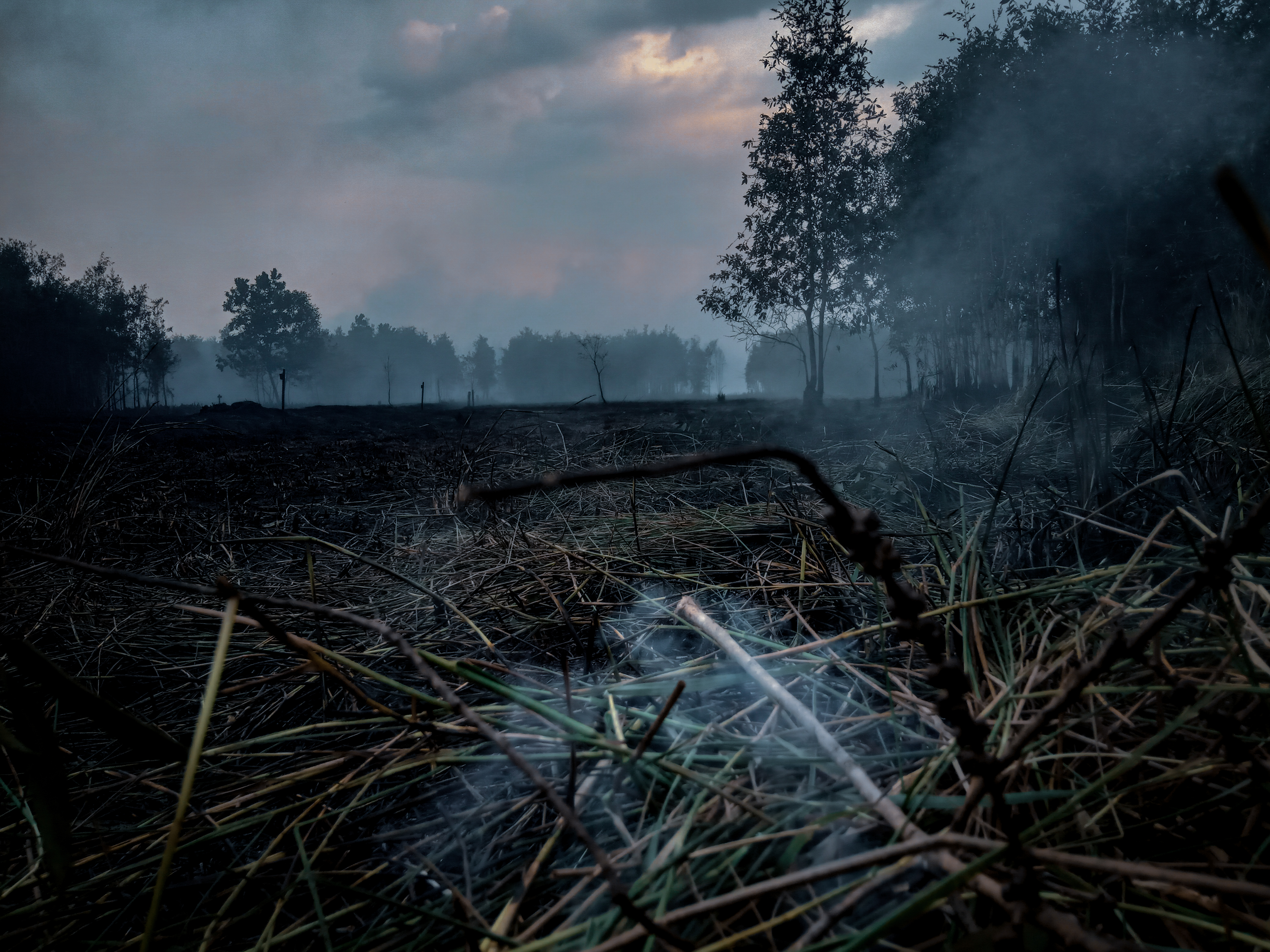
Peatland fires in Indonesia leave lasting damage to ecosystems and local livelihoods, highlighting the urgent need for environmental restoration, corporate accountability, and compensation for affected communities. Photo: Muhammad Pasya Ramadhan / Wikimedia Commons (CC BY-SA 4.0).
On the night of 26 September, Lisna, a 29-year-old teacher in Banjarmasin, South Kalimantan, told her mother that her chest hurt and she could not breathe. Lisna had asthma, and her family says that during September's haze she needed her nebulizer almost every day instead of about once a month. Before leaving for hospital, she asked her mother to look after her child. She died soon after, according to Mongabay Indonesia.
Her death may never be traceable to any company in a courtroom. But the same fires left losses the law can count and, in principle, repair. The province's health office recorded more than 48,000 respiratory infections during the burning season. Near Banjarbaru, a farmer named Kasman watched four hectares of durian, orange and avocado trees burn in August; he could not bear to calculate what he had lost, and he does not know where the fire began. For him, repair has a meaning a cheque could actually meet.
Governments are beginning to respond. On 27 October, Indonesia and Singapore announced plans to establish a joint task force to share information and financial intelligence and, where possible, recover assets linked to the fires. “Smoke can cross borders, so can money,” Indonesia’s foreign minister, Arrmanatha Nasir, said, as The Straits Times reported. On 4 November, Singapore’s Parliament passed amendments to its transboundary haze law, raising the maximum fine tenfold to S$20 million once the amendments come into force, according to Bernama.
All of this is welcome. But it answers two questions, how to stop the next fire and how to punish those responsible. A third goes almost untouched: who repairs the damage already done? A fine can be paid without a single hectare of peat being restored, and without a single family being compensated. In the haze debate, prevention, punishment and repair are treated as three separate things. On peatland they are one. The peat that burns is usually peat that has been drained, and once drained, it burns again. Restoring it means rewetting the land, returning native vegetation and rebuilding livelihoods that do not depend on keeping it dry, as a 2024 study of Central Kalimantan's peatlands sets out. A landscape left unrestored is not the scar of the last fire; it is the fuel for the next one.
Indonesia knows this gap well. After fires burned around 1,000 hectares of the Tripa peat swamp in Aceh, a stronghold of the critically endangered Sumatran orangutan, the courts ordered palm-oil company PT Kallista Alam to pay roughly Rp 366 billion: Rp 114 billion in damages and Rp 252 billion to restore the land. The Supreme Court upheld the ruling in 2015. Yet the company made its first payment, half the damages, only in September 2023, and agreed to pay the restoration amount in instalments, according to the environment ministry. A landmark victory, but eight years after the final ruling the money had only just begun to move, and the part meant to fix the land is still being paid in instalments.
Nor is Kallista Alam unique. Of 18 final judgments against fire-linked companies between 2015 and 2023, worth about Rp 6.1 trillion, only two had been paid in full, two more in instalments and the status of the rest was unclear, according to a 2024 Greenpeace review
Repair has a second half, for people, and it is failing worst. Compensation for residents does not happen automatically; they must document their losses and sue. A collective lawsuit by 11 residents in South Sumatra was rejected by a court in 2025. Greenpeace Indonesia said the court considered the residents’ claim unclear because it did not seek environmental restoration, although the court’s online notice reportedly gave no reason. The procedural dismissal left the substance of the residents’ claims unresolved. For people like Kasman, proving losses is also difficult: smoke travels across wide areas, while illness, lost income and damaged crops require different forms of evidence. Linking individual losses to fires in specific concessions can be especially challenging when residents do not know where a fire began. Kasman’s trees are gone, and nothing in the new arrangements yet promises him anything. Here the task force could matter even to him: tracing who owned and controlled the burning land is the first step toward knowing whom to claim against.
The strongest objection is that prevention must come first, and a bilateral task force is not a court. It cannot decide liability, award compensation or execute Indonesian judgments, and Singapore's law protects Singapore. All true, and I am not asking it to become a compensation tribunal. But it does not need to be one to close the repair gap. The tools it is building, such as tracing ownership, following money and recovering assets, are precisely the ones Indonesia has lacked when trying to collect what its courts already ordered. And on peat, repair is prevention: the two governments should say explicitly that their cooperation extends, where legally possible, to enforcing existing final judgments, not only to investigating new fires.
Two changes would make that real, one for each actor. First, the joint task force should prioritise companies with unpaid final judgments in its financial intelligence work, tracing ownership and recovering assets where legally possible. Second, in Jakarta, the environment ministry should establish a transparent system to ensure that court-ordered restoration actually happens. This should include a public scoreboard showing how much each company owes, how much has been paid and how much land has been restored; a dedicated, independently audited fund for restoration, tied to recovery plans and employing local communities; and the enforcement of Article 55 of Indonesia's Law No. 32 of 2009, which requires environmental permit holders to set aside restoration guarantee funds; before permits are granted or renewed.
Cleaner air next year would be a real achievement, and I hope the task force delivers it. But if accountability ends with a fine announced in Singapore or paid into a treasury in Jakarta, while the peat stays dry and families count their losses alone, we will have held companies liable on paper and left the fuel for the next fire in the ground. The test of this cooperation is not only whether the smoke stops. It is whether the damage is finally repaired.

Sahar Manzoor is a Social Sciences graduate and gold medalist from Pakistan. She a is currently pursuing Master of Public Policy (MPP) with a specialization in Climate Change at Universitas Islam Internasional Indonesia (UIII). Her academic interests focus on climate governance, social equity, and sustainable policymaking.
In this article, Sahar Manzoor argues that Indonesia’s response to...
This article examines how the systemic failure of urban waste...
Indonesia is spending Rp 75.8 trillion (around US$4.7 billion) building...
This article analyzes climate vulnerability across Economic Community of West...
This article argues that addressing climate change in the Global...
This article examines Indonesia’s transition from reactive emergency disaster spending...
This article examines the DRC–Rwanda peace accord through the lens...
This article offers a comparative reflection on how Islam has...
This article examines how youth-led, digitally networked movements are reshaping...
This article examines why forest-based approaches remain critical for addressing...
This article exposes the injustice of Afghanistan’s exclusion from COP30...
This article highlights the significant emotional and mental health burden...
This article defines Code Green as a model of public...
This article analyzes how China’s ambitious green transition serves not...
This article traces how the 2025 UN General Assembly turned...
This article looks at how Indonesia’s provinces with extensive biodiversity...
This article examines how climate change and privatization intersect to...
This article analyzes how Trump’s second time withdrawal from the...
This article critically analyses Pakistan’s worst floods ranging from the...
This article examines the climate vulnerabilities of Pari Island in...
This article traces how Pari Island in Jakarta’s Thousand Islands...
This article explores how ecotourism in Indonesia’s Thousand Islands generates...
This article compares how U.S. Presidents Joe Biden and Donald...
This article explores the devastating impact of human activities such...







Leave A Comment