
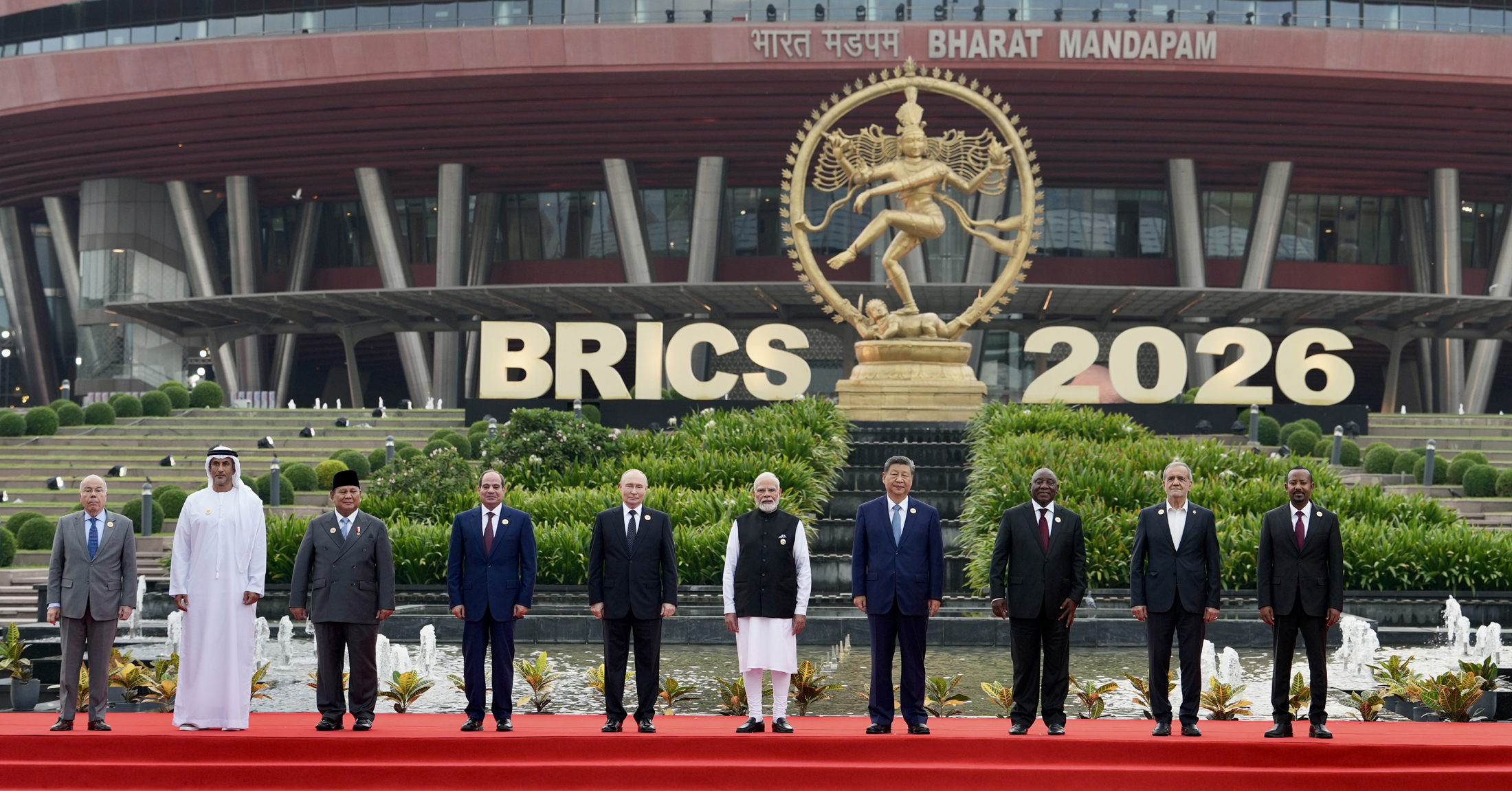
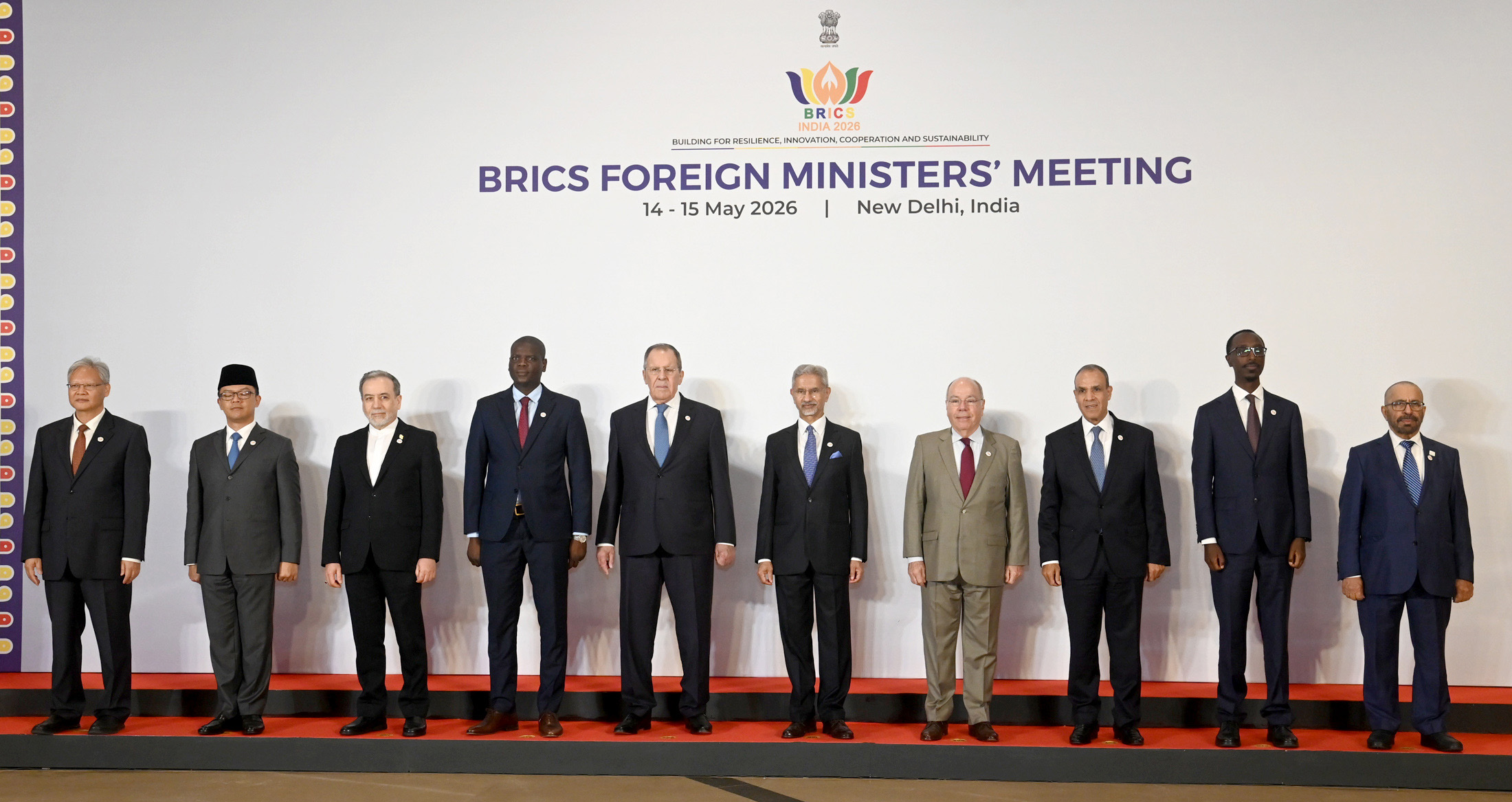
Leaders gather for a family photograph during the 18th BRICS Summit at Bharat Mandapam in New Delhi, India, on September 12, 2026. Source: Press Information Bureau (PIB), Government of India.
The eighteenth BRICS summit convenes at Bharat Mandapam on 12 and 13 September, in the twentieth year of the grouping's existence and after a chairship during which India has held more than 350 meetings across over twenty-five cities. Its theme, Building for Resilience, Innovation, Cooperation and Sustainability, will be read by most observers as the ordinary furniture of summitry. That would be a mistake this year, because the last of those four words has acquired a specificity the others lack, and because a decision on it was available in September.
The difficulty is easily stated, if less easily solved. Institutional capital responds less to the merits of a project than to whether it falls within a recognised classification, and the classifications governing global sustainable finance were drafted in Brussels, refined across a handful of European capitals, and exported outwards on the assumption that the rest of us would adopt them in due course. Whether a retrofitted blast furnace in Jamshedpur or a Javanese coal plant retired fifteen years early can be financed at tolerable cost is settled, in practice, by criteria written by people with neither asset in view. For the better part of a decade the emerging economies accepted this in the belief that recognition would follow alignment. Last month that belief was quietly retired.
In August the European Commission announced that it would not proceed to the next phase of the Common Ground Taxonomy or its multi-jurisdiction successor, the twin exercises through which Brussels, Beijing and Singapore had spent six years mapping their frameworks against one another. Its reasons were unremarkable and, from a European vantage, entirely defensible: limited appetite among European market participants, the resource cost of extending the work, and a concern to preserve the distinct legal character of the EU taxonomy. More instructive than the decision was the reminder that accompanied it, offered almost in passing, that these exercises had never constituted a common taxonomy, nor regulatory equivalence, nor mutual recognition between the frameworks they compared.
That reminder deserves dwelling upon, because a good many people in Delhi, Jakarta and Johannesburg had proceeded on the opposite assumption. The Common Ground Taxonomy, published at Glasgow in November 2021 and revised the following June, established that seventy-six mitigation activities were treated comparably by the European and Chinese frameworks; its multi-jurisdictional extension, presented at Baku in November 2024, brought in the Singapore-Asia Taxonomy and raised the count to one hundred and ten. Serious technical work, and I have made use of it myself. But a map of where two systems coincide is not an entitlement to be financed under either.
China's experience makes the lesson plain. The exercise began as a bilateral undertaking between the European framework and the People's Bank of China's Green Bond Endorsed Projects Catalogue, and Beijing treated it as considerably more than an academic courtesy: Chinese issuers relabelled green bonds against the CGT for placement with international investors, the trading system published a practice report on how the relabelling had performed, and Chinese officials co-chaired the taxonomy working group throughout. If six years of commitment on that scale, sustained by the largest green bond market in the world, can be wound up because European demand was judged insufficient, the economies standing further back in the queue might reasonably ask what they are waiting for.
The obstacle was never merely procedural. European taxonomy was designed for an economy in which the governing question is whether an activity aligns with a climate objective or fails to, and in which transition therefore appears as a category of exception, admitted grudgingly and hedged with justification. That architecture reflects European circumstances honestly enough. It reflects ours hardly at all. The great majority of abatement available in India, China, Indonesia, Brazil and South Africa lies not in building what does not yet exist but in improving what does: blast furnaces with thirty years of life in them, clinker kilns, captive generation attached to industrial estates employing hundreds of thousands. A classification that treats such assets as anomalies will misprice them however generously the anomalies are drawn.
Southeast Asia has shown the alternative to be workable rather than merely thinkable, its regional taxonomy having become the first anywhere to publish technical screening criteria for the early retirement of coal-fired power stations, a provision no European process would have generated. A BRICS standard would follow the same logic, and three provisions would carry most of its weight. It would classify hard-to-abate industry by emission intensity measured against a dated sectoral pathway rather than by membership of an eligible-activity list, so that a plant improving on schedule is financeable on its trajectory instead of disqualified by its starting point. It would treat a verified and dated closure schedule for existing thermal generation as an eligible transition asset in its own right. And it would recognise energy access and industrial capacity formation as environmental objectives rather than social side conditions, on the unglamorous ground that displacing diesel and biomass is abatement.
India, for its part, stands nearer to this than its diplomacy admits. The draft climate finance taxonomy released by the Ministry of Finance in May 2025, intended to direct something in the order of 250 billion dollars a year, already contains a distinct transition category addressed to steel and cement. Fourteen months after the consultation closed, it remains unnotified. There is something faintly comic in a country assembling the machinery for a transition-first standard while continuing to seek the approval of frameworks built upon the contrary premise, and something considerably less comic in what the delay is costing.
The arithmetic does not permit indefinite deliberation. The Independent High-Level Expert Group on Climate Finance places the annual investment requirement of emerging markets and developing countries other than China at roughly 2.4 trillion dollars by 2030, rising to between 3.1 and 3.5 trillion by 2035. Against that, the settlement reached at Baku produced a floor of 300 billion dollars a year by 2035 and an aspiration towards 1.3 trillion. The shortfall will not be closed by transfer from the developed world. It will be closed, if at all, out of domestic savings and South-South flows, which require a classification written for the assets they will actually be asked to finance.
A standard of that kind needs an institution behind it rather than a paragraph in a communiqué, and within BRICS only the New Development Bank qualifies. It had approved some 39 billion dollars of projects by the end of 2024, with roughly a quarter of its lending denominated in members' currencies, and its membership already extends well beyond the founding five, to Bangladesh, the United Arab Emirates, Uruguay, Egypt, Algeria, Colombia, Ethiopia and Uzbekistan. Its balance sheet is not the argument; set against the figures above it is barely a rounding error. The argument is that an institution able to decline to lend against whatever a taxonomy excludes can make that taxonomy operative, after which it travels, to the China Development Bank, to the national development banks of the members, and to the domestic insurance and pension pools that must in the end supply the overwhelming bulk of the capital.
None of which disposes of the objections. A grouping containing Russia, Iran and the Gulf states alongside Brazil will not arrive at a credible standard by consensus, and one permissive enough to command unanimity would raise the cost of capital for scrupulous issuers rather than lower it; the remedy is a coalition of the willing, with published criteria, independent verification and an accession route for those who later qualify. Beijing, for its part, would have to accept a standard it does not solely author, which is a larger concession than it may appear. Nor would it be sensible to pretend that European and Japanese institutional capital has ceased to matter. It matters somewhat less each year, which is rather the point.
India has spent this chairship arguing that BRICS ought to produce practical outcomes in place of declaratory ones, and here is one available in September at no fiscal cost whatever. The sequence that has governed sustainable finance for a decade, under which the developing world aligns first and negotiates afterwards, has been carried to its conclusion and found wanting. The alternative is not complicated: write the standard, attach it to capital that will lend against it, and allow recognition to arrive later as an acknowledgement of scale rather than as a favour granted at somebody else's convenience.

Shaurya Ritwik is Managing Director of the International Institute for Sustainable Finance. He writes on finance, trade, economics and geopolitics.
BRICS faces a choice: continue seeking recognition from Western-designed sustainable-finance...
In this article, Firda Amalia Putri examines Indonesia’s defensive diplomacy...
Indonesia’s ambitious defence modernisation is reshaping how Southeast Asia and...
Aniello Iannone examines Malaysia's repatriation of Myanmar nationals, revealing how...
In this article, Dr. Angana Guha Roy argues that water...
In "Structural Aseanisation," Aniello Ianone explores Europe's strategic shift in...
In this article, Aniello Iannone critically evaluates the ten-year trajectory...
The global order is moving beyond rigid bloc politics toward...
In this article, Luo Chen Jun highlights a striking historical...
In this article, Muhamad Ferdy Firmansyah highlights how climate technology...
In his latest article, Aniello Iannone examines the gap between...
This article analyzes Indonesia's ambitious military modernization through its strategic...
DeepRare is being hailed as a major breakthrough in the...
This article analyzes President Prabowo’s decision to skip the June...
This article analyzes the phenomenon of "sibling rivalry" at the...
This article evaluates the normative frameworks offered by China’s four...
This article examines the 2025 Thailand–Cambodia border conflict to evaluate...
This article examines the May 2026 ASEAN Summit in Cebu...
This article examines the May 2026 Beijing summit between Xi...
This article examines how the rise of narcissistic foreign policy—exemplified...
In October 2025, Indonesia's President Prabowo Subianto announced that Portuguese...
This article argues that recent U.S.–Israel military actions against Iran...
This article examines Türkiye’s evolving "Third Way" in Africa, an...
This article critically examines Indonesia’s evolving role from a quiet...





Leave A Comment