
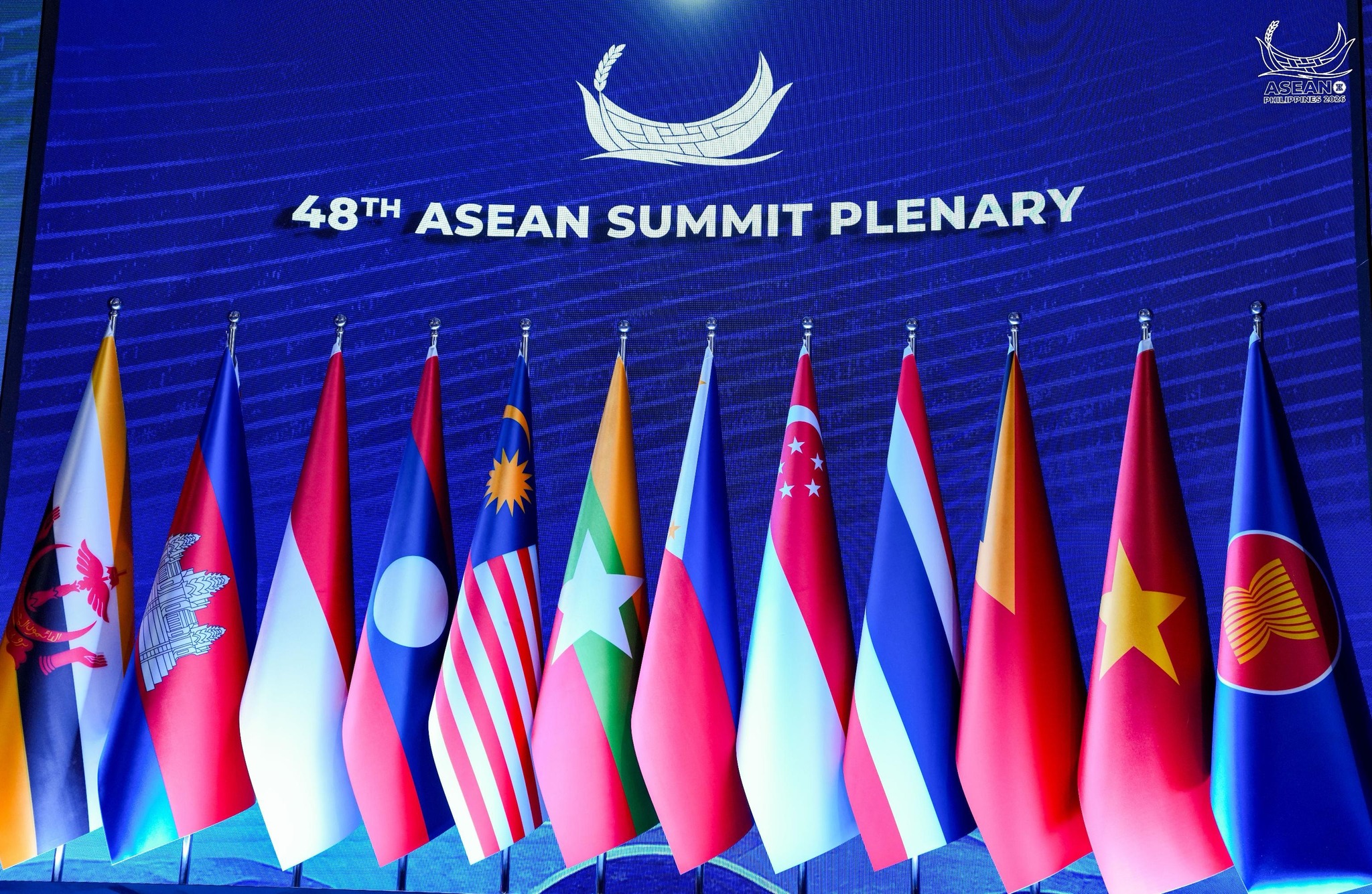
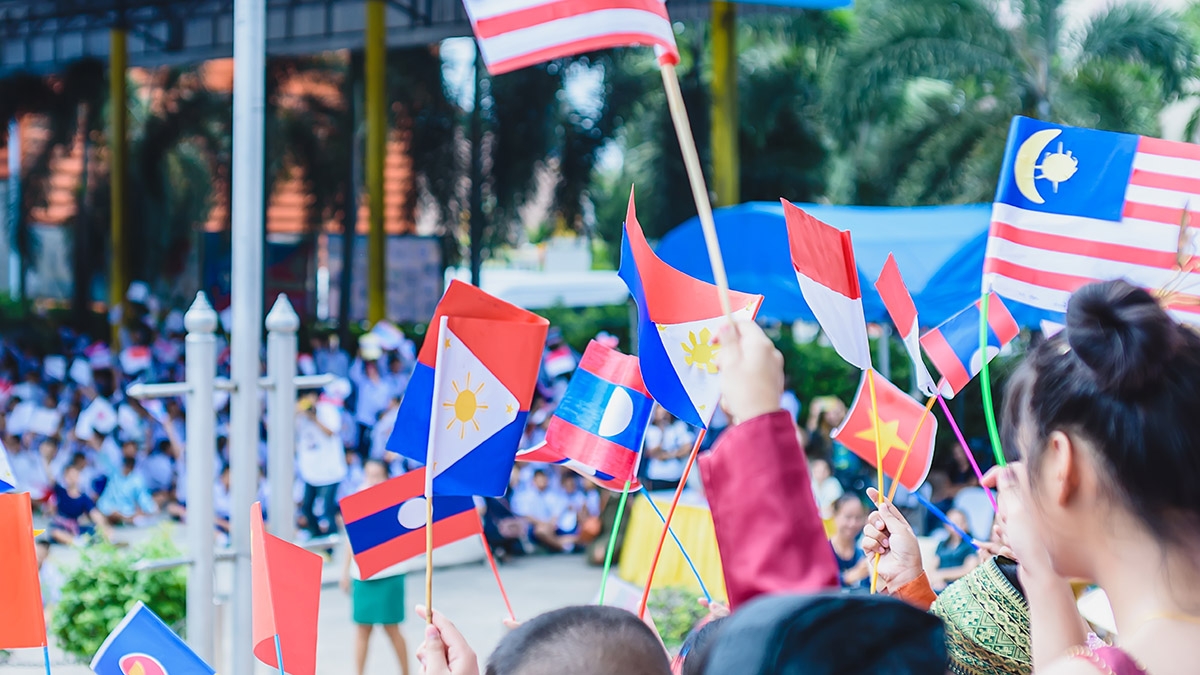
Image credit: ASEAN country flags the 48th ASEAN Summit Plenary, via Wikimedia Commons.
Amid increasing global uncertainty, efforts to realize a peaceful world must be reinforced. The world, which is now heading toward a multipolar one, requires refreshed values and norms to guide interactions between states. If the unipolar world was governed by the logic of domination, the multipolar world should be governed by consensus and inclusivity. But it is, as Xi Jinping once said, not only by hoping or talking, but through actions accompanied by the principle of harmony between what is said and what is committed (China Daily, 2022; Embassy of the People's Republic of China in the Republic of Iraq, 2017).
A harmonious multipolar world has to be a hope for many. But the rise of developing states toward more symmetrical power is not sufficient; it should be accompanied by respect for equality, sovereignty, and international law. It also must avoid the formation of exclusive blocs. The problem is that unipolarity is filled with injustice because it relies only on power hierarchy to manage the global order.
Multipolarity, therefore, is deemed the opposite: it redistributes power more evenly among states and gives them a greater role within a more impartial global order, in line with their actual power and capability. To that point, principles of equality, inclusivity, and a peaceful approach to disputes among states are urgently needed. Such principles are respectively found in the form of four initiatives China offers and in the practical terms of how ASEAN manages the relations and interactions among its members.
Rising China and ASEAN's success in achieving stability in the region, indeed, have provided fresh principles and values in operating such a global order. Despite the criticism of it, input should be taken carefully to make such principles and values valuable. The fact is, hitherto, these alternatives are the only ones available. China proposes a concept, the so-called four initiatives for the world. It includes successively, the Global Development Initiative, the Global Security Initiative, the Global Civilization Initiative, and the Global Governance Initiative (Guo Jiping, 2025; Tedeku, 2024; Venkataraman, 2025). ASEAN, for its part, has shown its capability in managing regional stability with the framework of the ASEAN Way (Acharya,1997 ; Ebbighausen, 2017).
China claimed that all four initiatives offered are significant in creating a fairer and peaceful global order to embody “community with a shared future for mankind”. On the other side, ASEAN states repeatedly pointed to their success in maintaining harmony and increasing economic development. But these initiatives are not without flaws. In practice, there is a gap China and ASEAN should close before these principles are truly ready to be offered for the world.
What China’s four initiatives offer
The first initiative China offers is GDI. GDI prioritizes development above all else. In China’s mind, delivering development assistance, especially to the most requiring nations, must be prioritized. When the people celebrate their well-being, it means the state has met an underlying need of its citizens. When the people attain prosperity, it amounts to reducing criminality caused by poverty. The problem is, GDI often conceals a tendency to enlarge influence and strengthen the dominance of great powers over smaller ones.
The second is GSI. GSI emphasizes inclusivity and win-win solutions to problem-solving. With the current security architecture common to the world’s practice, rather than maintaining it, GSI proposed a new one namely avoiding the practice of dominance and exclusivity. GSI emphasized that security must be managed by a peaceful approach rather than an aggressive settlement. Offensive behaviors only escalate the tensions, not rectify them. The multipolar world needs such a security framework. However, GSI is magnificent on the surface but complicated in practice. Possessing material power often leads states to act beyond the restraints of law.
The next is the Global Civilization Initiative (GCI). Where the first two initiatives address development and security, GCI holds that the diminishing trust among civilizations should be restored by enhancing dialogue, thereby reducing misunderstanding and misperceptions. By learning others’ cultures, it not only alleviates the suspicion among civilized people but also cultivates unity among them. In the multipolar order, every civilization has to seek similarity, not dissimilarity. Yet wars among civilizations recur throughout human history. Even within Chinese civilization itself, many factions disagree with one another.
The last Chinese initiative is the Global Governance Initiative (GGI), which aims to bring fairness to the global rules-based order. Over time, the world has still been perceived through a binary lens of developed and developing countries. Within such an order, it is inevitable that developing countries invariably suffer from domination and abandonment. To this condition, China offers a new framework of world order with the principle of inclusivity and fairness in which hierarchy of powers and materials has no place in determining every decision within global institutions.
Multilateralism, which is a practical term echoed within GGI, thus, is the only way to step together in the multipolar world. But before accusing other parties, China has to acknowledge that its own economic and political cooperation has often carried undertones of dominance and unfairness.
What the ASEAN way offers a multipolar order
In spite of the existing shortcomings, China’s four initiatives have actually opened a debate to seek an ideal principle for a global multipolar order. If one looks closely at the points, these four Chinese initiatives could be synthesized into two respects. One is about how to drive the world into a cooperative posture, underlining the concerted attempt to address the common challenge, such as poverty, conflicts, etc. The second is how to manage divergences in terms of decision-making and problem-solving. Those two aspects in the second term for breaking divergence are found through the consensus-making process and inclusiveness. In sum, three values are embodied in the Chinese initiatives: cooperation, consensus building, and open engagement.
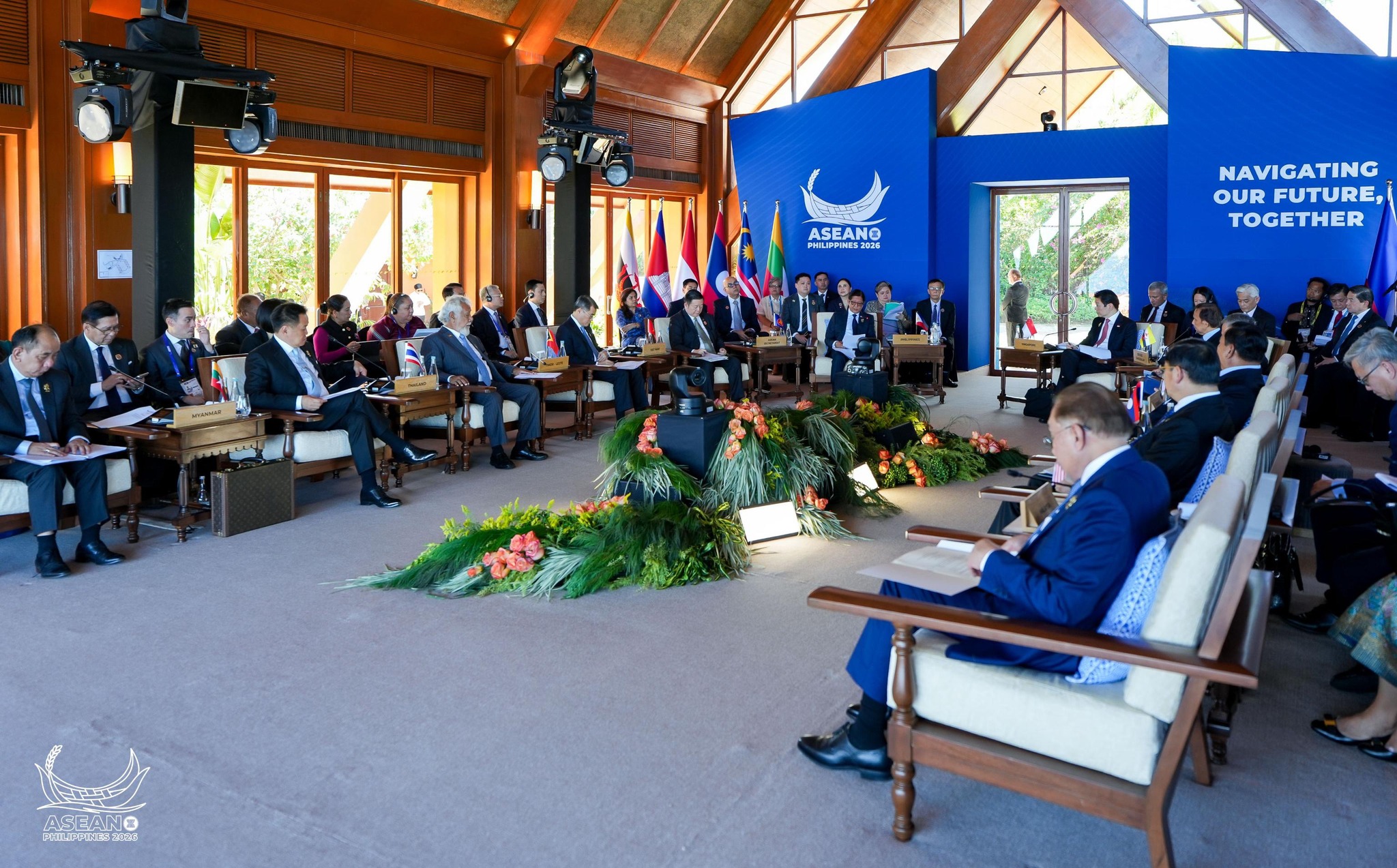
Intriguingly, all these guidelines are also found in the way ASEAN manages its cooperation within (among members) and with foreign actors. China and ASEAN are certainly learning about the institutional norms from each other. This is why they offer similar values and norms for the global order. ASEAN, like China’s initiatives, in its founding, has attempted to a great extent to discover a good method to manage diversity within its organization. With each member having a variety of political systems, ASEAN arguably succeeds in maintaining harmony and peace in terms of the regional context.
This was, to be sure, an accomplishment in which a group of developing states can sit together in cooperation and solve problems without resorting to aggressive measures. Conflict occasionally occurs among its members, but it can be eased under the ASEAN problem-solving framework.
In its dynamics and processes, such practices are so-called ASEAN way, namely consensus and soft regionalism (Acharya,1997), prioritizing inclusivity to strengthen the organization. ASEAN’s inclusivity means that everybody in the system of organization has its own right to argue about its objection and engage with respect to the solution it proposes. As long as its members give priority to the code of conduct of sovereignty and dialogue, without intervening in others’ domestic affairs and launching aggressive unilateral actions, despite being overshadowed by huge differences, ASEAN might still tolerate limited action, such as fierce debate regarding regional issues.
In short, the key to ASEAN’s success in managing a small multipolar world, in fact, lies in the mutual understanding grown within with intense communication and cooperation. ASEAN also implements consensus instead of veto as a settlement method to gather agreement among the members. This sort of decision-making has succeeded in reducing suspicions inherently rooted in the ASEAN political life. It means, even though ASEAN bears enormous differences, it is likely to put unity first rather than other matters. Problems can be talked through and solutions can be reached if each actor disregards their ego. It is what makes the ASEAN way sustainable in the regional context.
Conclusion
Whether China’s initiatives and the ASEAN way truly contribute to the multipolar order remains an open question. Overall, the principles both offer, if they are summarized, crystallize into two aspects that are needed for the global order, especially inclusivity and problem settlement with a peaceful approach.
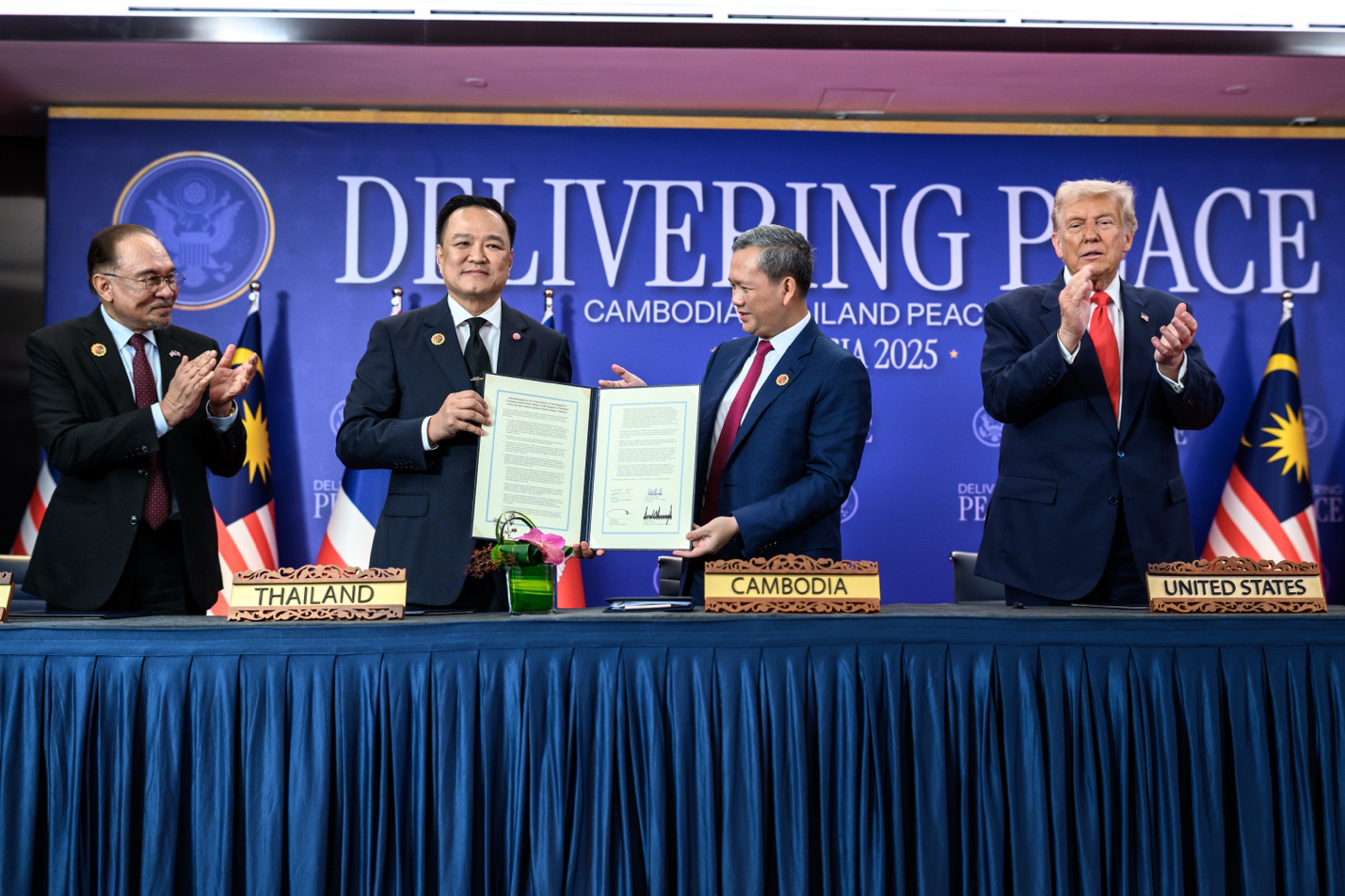
But again, in some cases, instead of overlooking international law, China itself has to value peaceful settlement, especially regarding the 2016 international arbitral ruling over the South China Sea. ASEAN, meanwhile, still struggles to secure a permanent peace between Thailand and Cambodia, as well as the internal strife within Myanmar. All of these problems will precisely erode the credibility of China’s four initiatives and the ASEAN way to be embraced as universal principles.
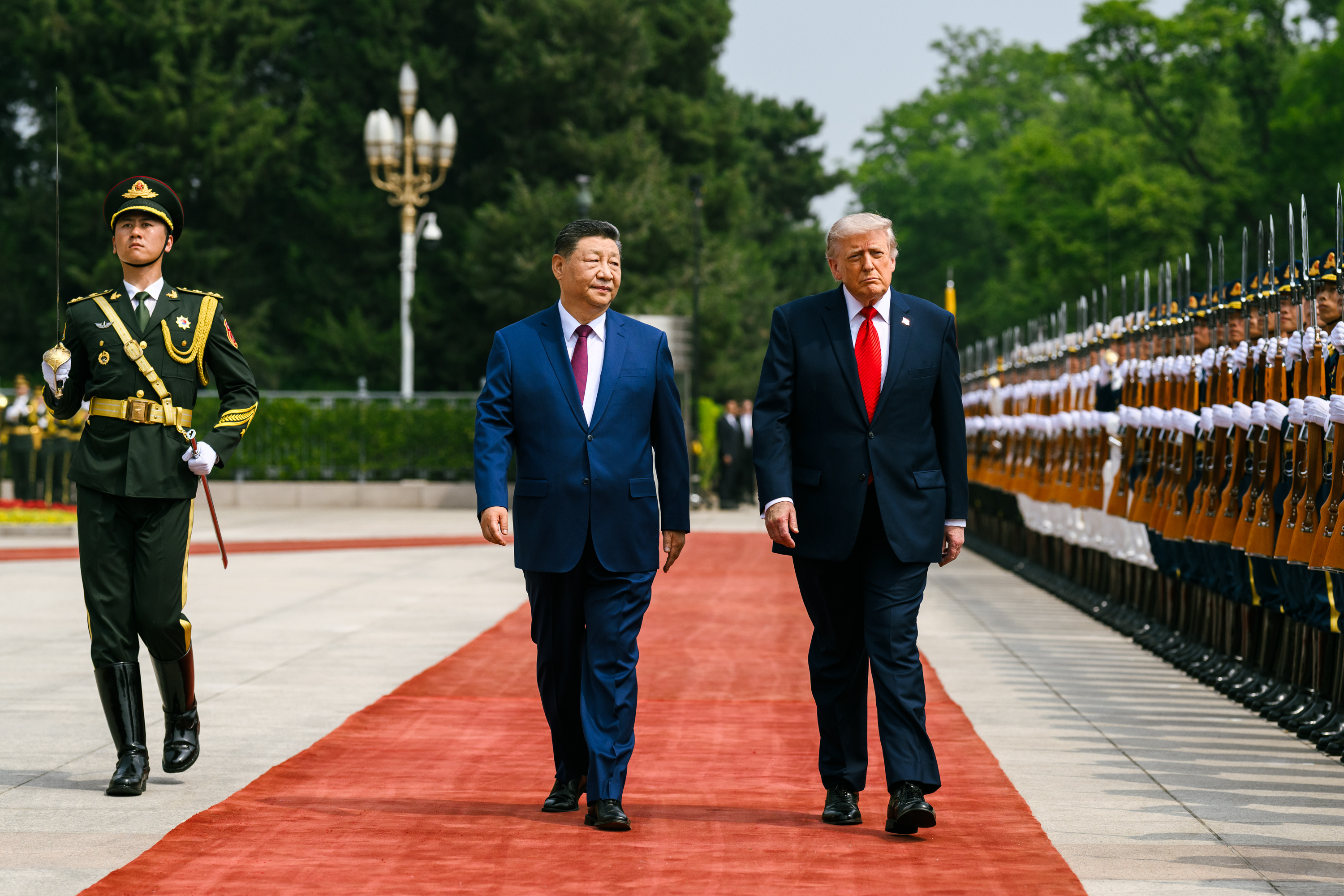
As Xi Jinping said, words must be proved by action. So, before China seriously offers its initiatives for a fairer multipolar order, it should prove it respects international law, however bitter that is to accept. ASEAN, which often touts the ASEAN way as an ideal principle in international forums, must prove that the recipe is not an empty one; tolerating a dragged-on conflict without definitive resolution undermines it.
Multipolarity, however, needs new principles and values that differ from the old style of unipolar order. Dominance and hegemony do not suit the new era, where the accumulation of power among states is increasingly symmetrical. The rise of developing economies requires a more inclusive, fairer, and mutually beneficial order, and there is no way to realize it other than through fresh values and norms. Despite the deficit within, China’s four initiatives and the ASEAN way have opened a new debate over whether they are suitable for a multipolar order or not.
Ahmad Nurcholis, a lecturer in the Faculty of Social and Political Sciences at Sriwijaya University, Indonesia. He earned a Master's degree in International Relations from Shandong University, China, and a Bachelor's degree in Political Science from Syarif Hidayatullah University, Jakarta.
The global order is moving beyond rigid bloc politics toward...
In this article, Luo Chen Jun highlights a striking historical...
In this article, Muhamad Ferdy Firmansyah highlights how climate technology...
In his latest article, Aniello Iannone examines the gap between...
This article analyzes Indonesia's ambitious military modernization through its strategic...
DeepRare is being hailed as a major breakthrough in the...
This article analyzes President Prabowo’s decision to skip the June...
This article analyzes the phenomenon of "sibling rivalry" at the...
This article evaluates the normative frameworks offered by China’s four...
This article examines the 2025 Thailand–Cambodia border conflict to evaluate...
This article examines the May 2026 ASEAN Summit in Cebu...
This article examines the May 2026 Beijing summit between Xi...
This article examines how the rise of narcissistic foreign policy—exemplified...
In October 2025, Indonesia's President Prabowo Subianto announced that Portuguese...
This article argues that recent U.S.–Israel military actions against Iran...
This article examines Türkiye’s evolving "Third Way" in Africa, an...
This article critically examines Indonesia’s evolving role from a quiet...
This article provides a firsthand account of how Pakistan emerged...
This article examines how disruptions in the Strait of Hormuz...
This article examines Indonesia’s participation in the Board of Peace...
This article examines what the attempted sale of CK Hutchison's...
This article examines the Kudankulam Nuclear Power Plant as a...
This article examines Nepal’s strategic position within the Indo-Pacific and...
This article analyzes Indonesia's participation in the US-led Board of...






Leave A Comment