
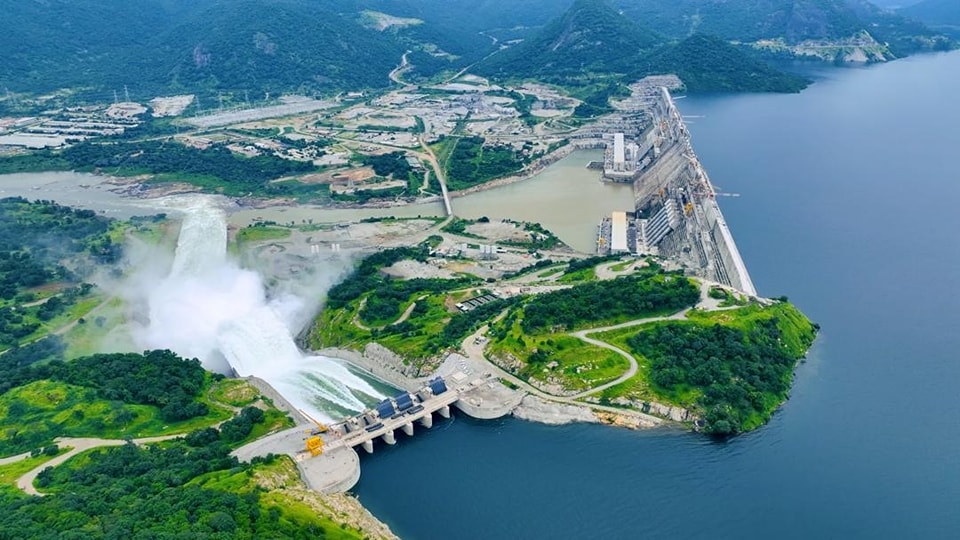
The Grand Ethiopian Renaissance Dam (GERD) on the Blue Nile reflects the growing geopolitical significance of transboundary water management and competing water-security interests in the Nile Basin. Credit: Sentinel-2 satellite imagery, 14 January 2022, via Wikimedia Commons
Water weaponization and hydro hegemony is one of the most critical geopolitical threats of the 21st century. Global water demand projected to outpace supply, by 40% by 2030, is transitioning into a strategic asset of state coercion. Nations leverage water, weaponizing geography (upstream advantage), targeting infrastructure, and inducing scarcity through various coercive mechanisms. Most of the river basins lack structured cooperative agreement leading nations to invest heavily in engineered water security mechanisms to counter the prevailing resource stress.
As witnessed during Operation Epic Fury, water became a primary target of asymmetric retaliation between US- Israel forces and Iran. The developments are more worrisome given the fact that gulf nations like Kuwait, Oman, and Saudi Arabia rely on 70- 90 % desalinated drinking water. A single point of failure or damage to desalination plants can cascade into massive humanitarian crisis. The modern spectrum of water insecurity is illustrated in a range of crisis spanning across the globe. A report in the Guardian early this year categorically drew attention to the fact that there has been a dramatic rise in water related violence.
Hydro-hegemony of Upper Stream Nations
Often been used by nations to exert geographical leverage transboundary rivers are flashpoints of modern security. The strategic landscape has evolved beyond language of threat to structural premises that pose challenges for downstream nations. A closer look at the power dynamics across four critical basins: Brahmaputra, Tigris- Euphrates, Nile, and Jordan narrates how water functions as a critical tool of weaponization.
The Brahmaputra river basin is at the focal point of cross border dispute spanning across China, India, and Bangladesh. The rapid expansion of hydropower projects by upper riparian China has exacerbated concern among the lower riparian nations like Indian and Bangladesh. China leveraged its upper riparian status for withholding hydrological from India during Doklam crisis in 2017. Thereafter, its approval of mega Medong hydropower project open speculations about the power it holds in flow regulation. Further the Medong project, located in a hyperactive seismic collision zone poses a downstream threat to India and Bangladesh. In order to counter China's ability to weaponize water flow India planned Upper Siang Multipurpose Project intended to act as a buffer reservoir.
The Tigris Euphrates rivers basin spanning across Turkey, Syria, Iran and Iraq is another text book case of hydro-hegemony. Turkey's massive water management initiative, Southeastern Anatolia Project along the Tigris and Euphrates rivers has significantly reduced the filing capacity of downstream countries like Syria and Iraq.
The Grand Ethiopian Renaissance Dam (GERD) funded by bonds and public contributions has reversed Egypt's multi decade hold on water resources of the Nile impacting its agriculture and hydroelectric power sector. While Egypt officially calls GERD 'illegitimate' asserting its right to protect its water security, Ethiopia's recent announcement of new hydropower projects has opened new flashpoints of dispute between two nations.
The Jordan River Basin depicts another example of an engineered crisis wherein Israel exercises absolute hydro-hegemony leaving Palestinian communities face artificial scarcity. While Israeli settlers retain access to higher amount of water resources in comparison to their Palestinian neighbors, Palestinians under restrictive laws and legacy treaties are blocked from even building basic water infrastructure, making them dependent on Israel’s national water company, Mekorot.
Scarcity Driven Water Conflicts
Water linked conflicts sits at the intersection of climate shocks, environmental hazards, resource stress, and negligent governance models.
Climate change and water insecurity nexus has elicited possibility of interstate frictions in Southeast Asia. With a water abundant footprint, the Mekong River Basin face challenges posed by pollution, and institutional fragmentation. China's South-to-North Water Diversion Project (SNWDP) diverting water from the Yangtze and its tributaries, threatens to impact the larger regional hydrology and occupational sectors (agriculture and fisheries) in downstream countries like Laos, Cambodia, and Thailand.
Central Asia has witnessed localized border clashes over water resources in Fergana valley in the recent past. As downstream nations in the Aral Sea basin, Turkmenistan and Uzbekistan face severe setbacks due to complete dependence on Syr Darya and Amu Darya basins. The failure of the upstream (Kyrgyzstan and Tajikistan) and downstream nations (Uzbekistan and Turkmenistan) to return to cooperative frameworks in the post-soviet era has prevented both sides from addressing a solution to the prevailing problems.
Sub- Saharan Africa and Southern Africa is yet another vulnerable zone that sits in the middle of climate shock, water scarcity, and rampant human security violation. Climate shocks like floods, droughts, and storms induce resource stress leading to complex security faultlines as in the case of Nigeria where armed groups tend to recruit vulnerable section of the population. Electricity and water cuts even prompted anti-government protests in Madagascar. Following citizens' protests in Johannesburg, South African Human Rights Commission (SAHRC) has called for a national disaster declaration regarding the country's severe water crisis.
Water scarcity is an important dimension of bilateral relations between conflict hotspot countries Pakistan and Afghanistan. The decision of the Taliban government to move ahead with its plans to divert water from the Kunar River towards the Nangarhar region in the country raise risk of conflict in the wake of climate induced water scarcity .
Emerging Technologies & Hydro Weaponization
Owners of digital communication infrastructures and data centers which require millions of gallons of water to cool down system servers often have to compete with locals to access clean fresh water. The tech driven resource strain has often triggered localized conflicts, public protests, and environmental court battles.
Amid severe water shortages in Montevideo (Uruguay), Google's proposed multi-million dollar data center that would consume a large amount of fresh water everyday led to major protests under the slogan "It's not drought, it's pillage'. The protests forced Google to shift to an alternative energy-heavy air-cooling system instead.
Similar proposed projects by private enterprises have evoked public protests, court battles, and wider ethical debates in Chile, Manhattan, Tennessee, and Illinois.
Since the critical digital infrastructures are emerging governments and multilateral groups are yet to voice demand for moratoriums, rules and laws that should be taken into consideration for such initiatives.
The Curse of Resources
Latin America has emerged as a global focal point in the fight for "water democracy treating water as a human right instead of a commodity. Despite holding one third of the freshwater, 150 million people in Latin America live in highly water-scarce areas, according to the World Bank. Freshwater reserves in the Amazon remain largely disconnected from urban habitation and agriculture zones.
Several case studies across the continent demonstrate that despite having a massive water footprint country across the continent face water scarcity due to lack of institutional coordination among countries, underutilization of investment, and absence of functional infrastructure.
In April 2026, widespread protests erupted across Argentina following the passage of a bill that aims to open up Andean region to large scale multinational mining operations, previously protected under National Glacier Protection Law, raising concerns about water security for over 7 million people. The move erupted multi front legal and political protests across the country.
A closer look at localized conflicts triggered by water scarcity in Bolivia, Chile, Peru, and Uruguay amplify the faultlines in the prevailing economic and governance model that insufficiently addresses the gap between availability and accessibility of ‘water’ as a public good.
Water, one of the most critical components of national security is at the center of multi-dimensional conflicts across the world. As a critical natural and strategic asset, it has drawn less attention of cooperative frameworks and dialogues in the multilateral forums in comparison to other non-conventional threats. Despite countless alarms international leaders have barely shown interest in adopting crisis mitigation measures to democratize universal water resource access, supremely fundamental to human security

Dr. Angana Guha Roy is an Independent Researcher based in New Delhi. She regularly writes on Foreign policy, Defence and International affairs. For any query contact at: anganaguharoy@gmail.com
In this article, Dr. Angana Guha Roy argues that water...
In "Structural Aseanisation," Aniello Ianone explores Europe's strategic shift in...
In this article, Aniello Iannone critically evaluates the ten-year trajectory...
The global order is moving beyond rigid bloc politics toward...
In this article, Luo Chen Jun highlights a striking historical...
In this article, Muhamad Ferdy Firmansyah highlights how climate technology...
In his latest article, Aniello Iannone examines the gap between...
This article analyzes Indonesia's ambitious military modernization through its strategic...
DeepRare is being hailed as a major breakthrough in the...
This article analyzes President Prabowo’s decision to skip the June...
This article analyzes the phenomenon of "sibling rivalry" at the...
This article evaluates the normative frameworks offered by China’s four...
This article examines the 2025 Thailand–Cambodia border conflict to evaluate...
This article examines the May 2026 ASEAN Summit in Cebu...
This article examines the May 2026 Beijing summit between Xi...
This article examines how the rise of narcissistic foreign policy—exemplified...
In October 2025, Indonesia's President Prabowo Subianto announced that Portuguese...
This article argues that recent U.S.–Israel military actions against Iran...
This article examines Türkiye’s evolving "Third Way" in Africa, an...
This article critically examines Indonesia’s evolving role from a quiet...
This article provides a firsthand account of how Pakistan emerged...
This article examines how disruptions in the Strait of Hormuz...
This article examines Indonesia’s participation in the Board of Peace...
This article examines what the attempted sale of CK Hutchison's...




Leave A Comment