
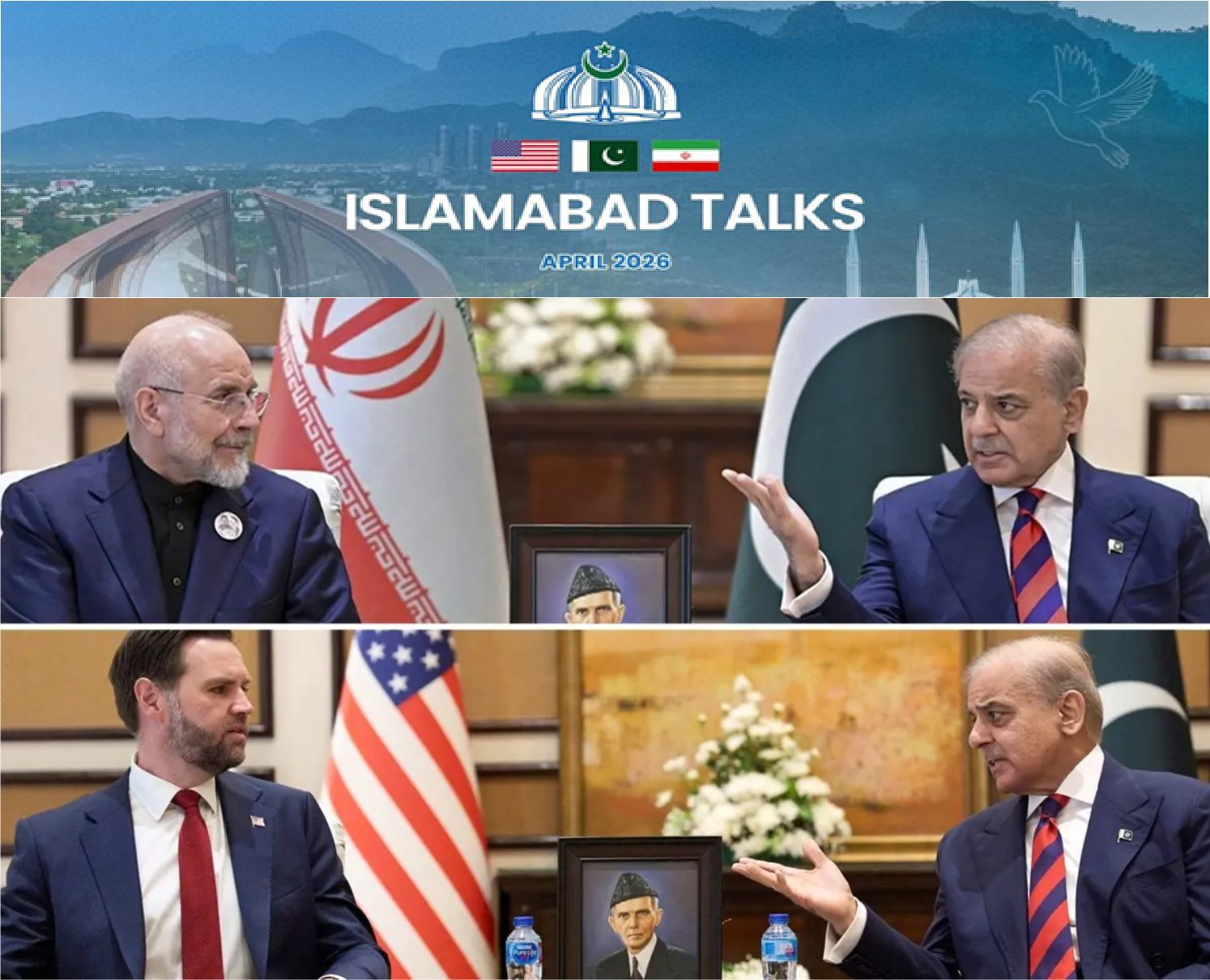
I sat glued to my screen through the long, tense night of April 8, 2026, in Peshawar, watching history unfold in real time. The world held its breath as a U.S. deadline loomed, one that threatened strikes on Iran, and a potential spiral into wider chaos. Phones buzzed with alerts, social media lit up with speculation, and sleep felt impossible. Yet, as the hours ticked by, something extraordinary happened as Pakistan stepped into the spotlight, not as a bystander, but as the calm, trusted bridge that pulled two adversaries back from the edge.
The process started with silent yet continuous work through backchannels. The mediation process which Pakistan started three days ago reached its peak during the night. I watched Prime Minister Shehbaz Sharif post a public post on X, urging President Trump to extend the deadline by two weeks to let diplomacy breathe. He requested Iran to restore operation of the Strait of Hormuz as a goodwill sign, and he suggested an immediate two-week ceasefire which would apply to all battle areas including Lebanon. Field Marshal Asim Munir maintained constant communication with important representatives from both parties throughout, including U.S. Vice President JD Vance and special envoys and Iranian officials. The “Islamabad Accord” framework, exchanged electronically through Pakistan as the sole trusted channel, outlined a clear path, immediate ceasefire, safe reopening of the vital waterway, and talks to follow.
As dawn approached on April 8, the breakthroughs arrived one after another. President Trump announced on Truth Social that, based on direct conversations with Prime Minister Shehbaz Sharif and Field Marshal Asim Munir, he was suspending planned strikes for two weeks, conditional on Iran’s complete, immediate, and safe reopening of the Strait of Hormuz. Iran’s Supreme National Security Council reciprocated swiftly, accepting the two-week ceasefire and halting operations if attacks stopped. The truce took effect immediately.
The news of Prime Minister Shehbaz Sharif's announcement through his personal social media page caused me to feel both pride and amazement because he spoke with his usual modesty. He expressed his gratitude to both governments while inviting U.S. and Iranian officials to visit Islamabad on Friday April 10th to engage in important discussions that would lead to a permanent solution. The situation brought relief because it would lead to market stability which would protect many lives.
What truly moved me was the outpouring of gratitude that followed. Iran’s Foreign Minister Seyed Abbas Araqchi publicly expressed “gratitude and appreciation for my dear brothers HE Prime Minister of Pakistan and HE Field Marshal Asim Munir for their tireless efforts to end the war in the region.” He credited Shehbaz Sharif’s “brotherly request” and Pakistan’s framework as decisive. President Trump himself named Shehbaz Sharif and Field Marshal Asim Munir personally in his announcement, highlighting how their engagement helped him “hold off the destructive force” in favor of a “double-sided CEASEFIRE.” It was a direct acknowledgment from Washington of Pakistan’s pivotal role.
Other voices joined in appreciation too. Regional and international figures welcomed the breakthrough, recognizing Pakistan’s quiet effectiveness in a moment when traditional mediators had struggled. From my vantage point, witnessing the notifications and statements roll in, it felt like the world was suddenly seeing Pakistan in a new light, not just as a credible mediator, but as a genuine geopolitical asset, and as a nation trusted by rivals because of its unique relationships, strategic position, and pragmatic approach that transcends blocs.
That night was not about grandstanding; it was about results. Pakistan leveraged decades of ties with the U.S., deep cultural and geographic connections to Iran, and strong Gulf partnerships to create a channel no one else could. In an era of multipolar tensions, where flashpoints can ignite global crises, Islamabad showed it can convene, de-escalate, and deliver where others cannot.
My continuous monitoring of updates, which began with anxiety on that tense night of April 8 and evolved into deep admiration over the weekend, now leaves me profoundly impressed and hopeful. As the high-stakes talks unfolded in Islamabad, extending more than 21 hours across Saturday and into Sunday (April 12), Pakistan once again demonstrated its unique value as a neutral bridge. Although the direct negotiations between the U.S. delegation, led by Vice President JD Vance, and Iranian officials did not produce a comprehensive final agreement, with differences remaining on long-term security guarantees and regional issues, both sides acknowledged the constructive atmosphere and Pakistan’s tireless facilitation.
Prime Minister Shehbaz Sharif and Field Marshal Asim Munir remained actively engaged, hosting sessions that kept communication channels open and prevented any immediate collapse of the fragile two-week ceasefire. Vice President Vance publicly thanked Pakistan’s leadership for creating this vital platform, noting that the extended dialogue helped sustain momentum toward peace. However, President Trump ordered a blockade of the Strait of Hormuz after the negotiations failed to produce a breakthrough, sending the crisis into a much more explosive phase whose developments would need to be closely watched. Pakistan has achieved a stronger global status that combines modesty in the face of both triumphs and challenges with a determined pursuit of national and regional objectives. This weekend’s efforts, though falling short of a permanent solution, have reinforced the established precedent of effective backchannel diplomacy and transformed international perceptions of Pakistan’s role.
What a time to witness, and what an enduring moment for Pakistan.
Note: This article is an update of “Pakistan Emerges as a Geopolitical Asset in the World Order” published by South Asian Journal on April 8, 2026.

Farwa Imtiaz is an independent academic researcher with Masters in Peace and Conflict Studies from National Defence University, Pakistan. Her areas of interest include Conflict Analysis, Geopolitical Realities, Climate Change, and International Affairs. Her work is Published on The Friday times, Paradigm Shift, Policy Wire, South Asia Times, Voice of Germany, Global Connectivities, Stratheia and International Policy Journal.
In "Structural Aseanisation," Aniello Ianone explores Europe's strategic shift in...
In this article, Aniello Iannone critically evaluates the ten-year trajectory...
The global order is moving beyond rigid bloc politics toward...
In this article, Luo Chen Jun highlights a striking historical...
In this article, Muhamad Ferdy Firmansyah highlights how climate technology...
In his latest article, Aniello Iannone examines the gap between...
This article analyzes Indonesia's ambitious military modernization through its strategic...
DeepRare is being hailed as a major breakthrough in the...
This article analyzes President Prabowo’s decision to skip the June...
This article analyzes the phenomenon of "sibling rivalry" at the...
This article evaluates the normative frameworks offered by China’s four...
This article examines the 2025 Thailand–Cambodia border conflict to evaluate...
This article examines the May 2026 ASEAN Summit in Cebu...
This article examines the May 2026 Beijing summit between Xi...
This article examines how the rise of narcissistic foreign policy—exemplified...
In October 2025, Indonesia's President Prabowo Subianto announced that Portuguese...
This article argues that recent U.S.–Israel military actions against Iran...
This article examines Türkiye’s evolving "Third Way" in Africa, an...
This article critically examines Indonesia’s evolving role from a quiet...
This article provides a firsthand account of how Pakistan emerged...
This article examines how disruptions in the Strait of Hormuz...
This article examines Indonesia’s participation in the Board of Peace...
This article examines what the attempted sale of CK Hutchison's...
This article examines the Kudankulam Nuclear Power Plant as a...


Leave A Comment