
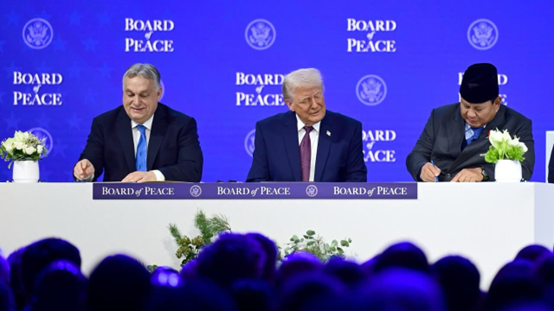
Image credit: Sekretaris Kabinet (Indonesian Cabinet Secretariat) via Wikimedia Commons
When it comes to Islam in Indonesia's foreign policy, it is customary for local actors to participate and for the leader to maintain a balance between domestic and foreign policy. In recent days, Indonesia's participation in the Trump-initiated Board of Peace (BoP) and its contributions to the BoP within this framework have become one of the most important agenda items. To understand the logic behind Indonesia’s BoP participation, this piece will compare it with the Suharto administration's stance on the Bosnian War, which shows that Islamic issues have long served as instruments of moral signaling rather than a new agenda in Indonesian foreign policy. Behind this situation lie two factors: leveraging international status and protecting domestic legitimacy against the West.
Also, the comparison between Suharto and Prabowo is based on two elements: both are military men who view global politics through a realist lens. Second, they both came from similar ideologies, secular nationalism. The limitations imposed both domestically and internationally on the application of foreign policy logic are what shift, not the logic itself.
Prabowo and BoP: Rowing between Domestically and Internationally
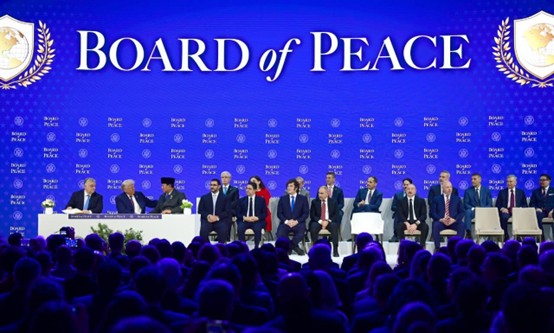
In January/2026, Indonesia joined the Board of Peace along with several other Muslim countries, including Qatar, Pakistan, Türkiye, and Saudi Arabia. The establishment plan behind the board is to carry out the ceasefire between Israel and Hamas and the Gaza Strip's post-conflict rehabilitation. In the meantime, over 25 nations include China, Brazil, India, Japan, the Netherlands, Russia, South Korea, Singapore, Switzerland, Thailand, and Ukraine, that were invited to join the Board of Peace declined the proposal.
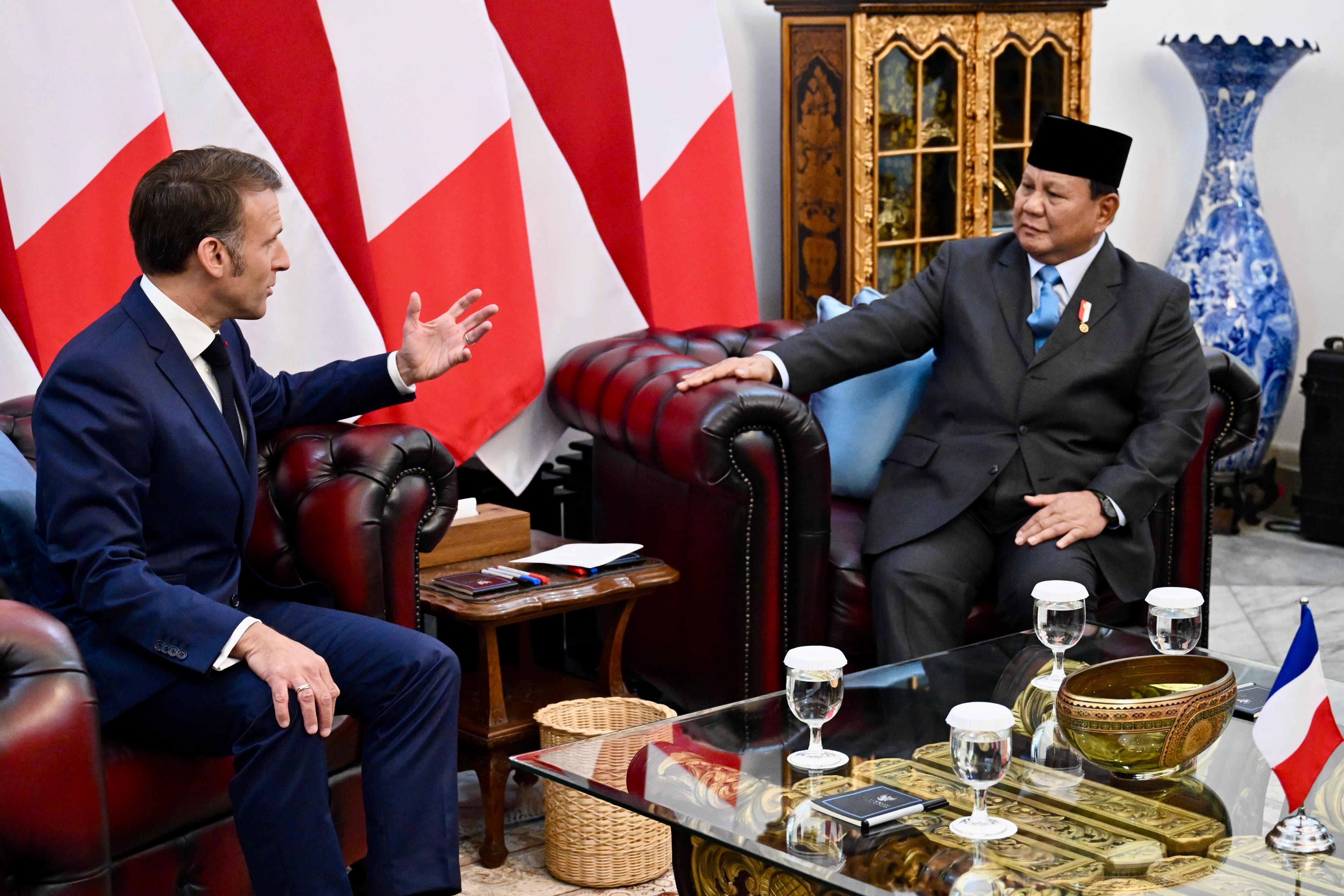
Recently, in accordance with present plans, Indonesia has indicated that it is willing to send troops to Gaza, possibly as many as 1,000 in the first phase, with talks continuing regarding a larger deployment should circumstances permit. Many Islamic organisations seem supportive of sending troops to Gaza, although some of them had opposite views in the beginning. However, after meeting with President Prabowo, Indonesia’s major Islamic organisations recalibrated their positions and gave their support to Prabowo, including Nahdlat’ul Ulama, Muhammadyah, and MUI, while conditioning their support on the two-state solution. This shows that President Prabowo has already secured its domestic legitimacy from the main Islamic actors before implementing any potential troop contribution to Gaza to confront any domestic backlash soon. That legitimacy is not optional for a leader who was just elected a year ago.
On the one hand, some analysts assert that, in addition to managing growing domestic expectations, Prabowo’s active role in BoP is driven by US-Indonesia economic relations or short-term gains. Recently, a trade deal between the US and Indonesia was finalised, reducing US taxes on Indonesian exports from 32% to 19%. The Prabowo administration apparently does not want to jeopardies the country’s economic stability internationally, especially regarding the fiscal burden of expansive social programmes. As a leader elected a year ago, any possible economic difficulties that Prabowo faces internationally may cause turbulence for his legitimacy in domestic politics and increase public attention.
To better understand the logic behind Prabowo’s engagement with the Board of Peace, it is useful to revisit an earlier episode in Indonesian foreign policy under President Suharto, when Jakarta chose to engage with the Bosnian War through diplomatic and symbolic means rather than military deployment.
Bosnian War and Suharto
The logic behind Prabowo's BoP membership and Suharto's involvement in the Bosnian War is similar. Although one of the reasons was to demonstrate Islamic solidarity with the Islamic world, in the early 1990s the slowdown in Indonesia's financial sector and Suharto's rapprochement with Islamic actors directly influenced his stance on the Bosnian War.
Suharto was a leader nicknamed “Bapak Pembangunan” (The Father of Development). This nickname was not a coincidence. The Indonesian economy experienced significant growth under his presidency until the 90s, at approximately 6-7 per cent annually. Despite the authoritarian nature of his regime, this economic performance provided Suharto with strong domestic legitimacy until the early 1990s. As growth slowed and socio-economic pressures mounted—culminating in the 1997 Asian Financial Crisis—Suharto increasingly sought alternative sources of legitimacy. As a response, Suharto selectively opened political space for Islamic actors—most notably through the establishment of ICMI (Indonesian Association of Muslim Intellectuals) and closer ties with the so-called “green faction” (kelompok hijau) within the armed forces. Bosnia, in this context, became an external arena through which these domestic recalibrations were symbolically reflected.
In Indonesian domestic discourse, Bosnia War held a unique position. Indonesian Islamic organisations put more and more pressure on the government to show support for Bosnian Muslims as the conflict grew to be a major concern for Muslims around the world. Although Islamic actors pressured the government to cut diplomatic ties with Yugoslavia, the Suharto administration sought to transfer the NAM presidency from Yugoslavia to Indonesia, considering Indonesia’s global image. Instead of sending combat units, the Indonesian government ultimately chose to send only a few military officers and observers. To ease domestic concerns, Suharto visited Sarajevo in 1995 to show solidarity and reinforce moral legitimacy, without provoking tensions with Western powers.
Conclusion
From Bosnia to the Board of Peace, Indonesian leaders have frequently addressed Islamic issues as tools for managing legitimacy and sending moral signals rather than as ideological commitments. Leaders may change, regimes may transform, and global power structures may evolve, yet the underlying logic remains remarkably consistent. The constraints that foreign policy operates under, both domestically and internationally, are what vary over time rather than the logic of Indonesian foreign policy. In this way, Prabowo's involvement with the Board of Peace is more a continuation of a well-known diplomatic custom than a break with Indonesia's past. Therefore, in order to comprehend Prabowo's involvement in the Board of Peace, one must consider both current geopolitical calculations and Indonesia's longer history of moral signaling as a middle power seeking influence without escalation.

Dr. Tufan Kutay Boran is currently a Lecturer at the Social Sciences University of Ankara. He received his Ph.D. from the Department of Politics and Government at Universitas Gadjah Mada. His research interests lie primarily in Indonesian domestic and foreign policy, political parties, and the role of local actors in the formulation of foreign policy. Dr. Boran has authored several scholarly articles and book chapters on Indonesian foreign policy, published in both English and Turkish.
In this article, Aniello Iannone critically evaluates the ten-year trajectory...
The global order is moving beyond rigid bloc politics toward...
In this article, Luo Chen Jun highlights a striking historical...
In this article, Muhamad Ferdy Firmansyah highlights how climate technology...
In his latest article, Aniello Iannone examines the gap between...
This article analyzes Indonesia's ambitious military modernization through its strategic...
DeepRare is being hailed as a major breakthrough in the...
This article analyzes President Prabowo’s decision to skip the June...
This article analyzes the phenomenon of "sibling rivalry" at the...
This article evaluates the normative frameworks offered by China’s four...
This article examines the 2025 Thailand–Cambodia border conflict to evaluate...
This article examines the May 2026 ASEAN Summit in Cebu...
This article examines the May 2026 Beijing summit between Xi...
This article examines how the rise of narcissistic foreign policy—exemplified...
In October 2025, Indonesia's President Prabowo Subianto announced that Portuguese...
This article argues that recent U.S.–Israel military actions against Iran...
This article examines Türkiye’s evolving "Third Way" in Africa, an...
This article critically examines Indonesia’s evolving role from a quiet...
This article provides a firsthand account of how Pakistan emerged...
This article examines how disruptions in the Strait of Hormuz...
This article examines Indonesia’s participation in the Board of Peace...
This article examines what the attempted sale of CK Hutchison's...
This article examines the Kudankulam Nuclear Power Plant as a...
This article examines Nepal’s strategic position within the Indo-Pacific and...



Leave A Comment